Shetland Adventures, 2026
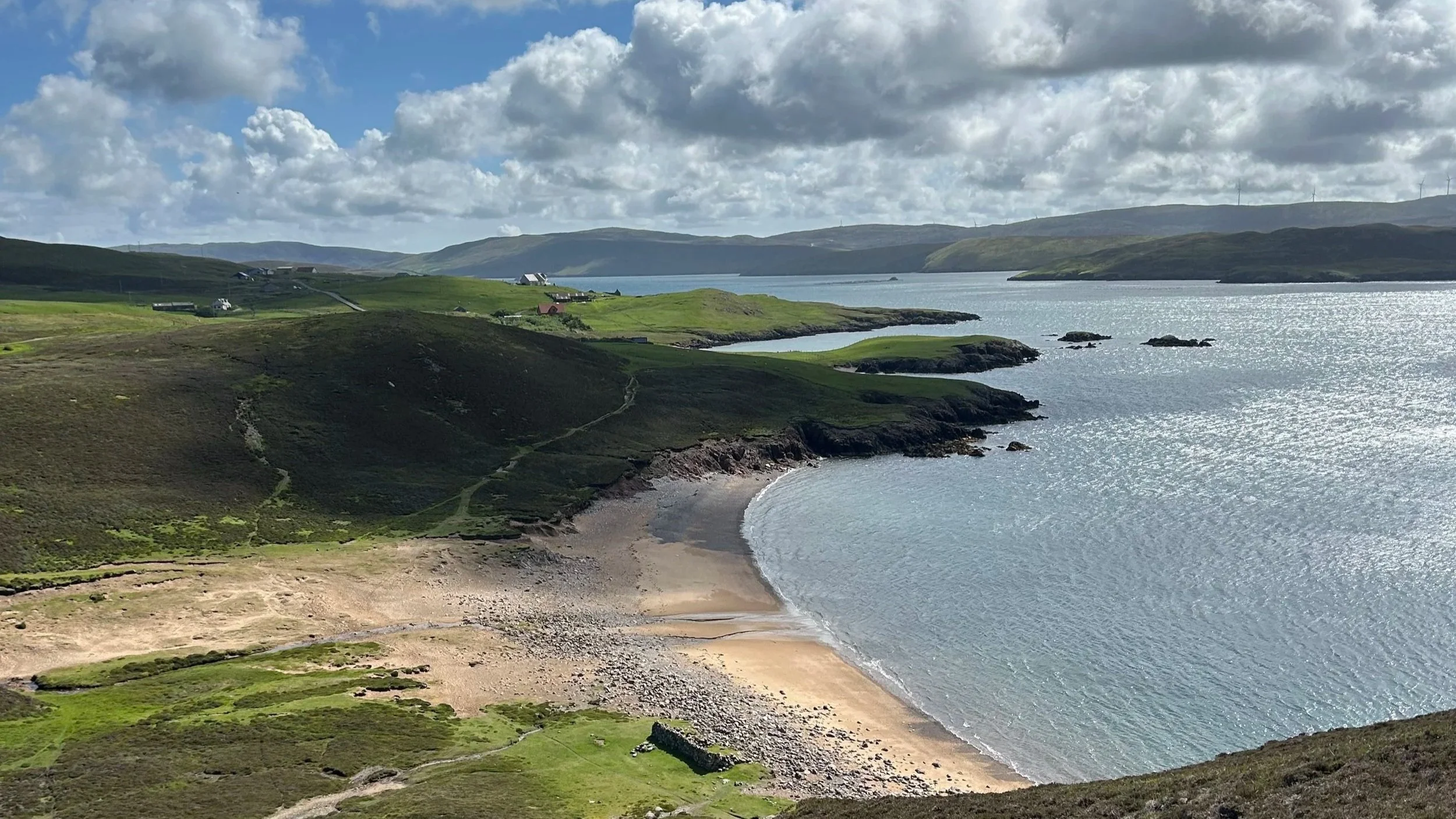
Muckle Ayre Beach, Muckle Roe Island
This year my husband and I decided to go to the Shetland Islands for our vacation. We had been watching the BBC series Shetland based on the detective novels by Ann Cleeves. They feature detective Jimmy Perez, played in the series by a handsomely scruffy Douglas Henshall, and members of his team, the irrepressible Tosh, the querulous but tech-savvy Sandy, and Billy, the old-timer on the team. I ordered a set of the novels, and Wally got to work on the logistics of the trip. The major find was Wilderness Scotland that runs organized guide-led walking and adventuring expeditions. We would fly from Atlanta to Amsterdam and then to Aberdeen, Scotland, where we would spend a night and have time to wander about the city. Then we would take the overnight ferry to Lerwick in the Shetland Islands, where we would be met by our guide Douglas, gather the other members of our walking group, and check in at our vacation headquarters, the 16th-century Busta House further up the island. The return would simply follow the same itinerary in reverse.
Our adventures began (6/17) as we arrived at the Atlanta airport extra early for our 7:45 pm flight. After checking in we headed to TGIF for wings, and wine for me. Then to the gate to wait to board the overnight flight to Amsterdam. The gate was filled with people flying to Amsterdam, women in wheelchairs, families with toddlers, teens, older couples like us, one the wife in wheelchair with husband dressed in matching beige jogging suit—a medley of faces and ethnicities. And then we sat on the tarmac for 1 ½ hours due to “paperwork” issues, causing us (and many others) to miss connecting flights.
Once in Amsterdam we got a new flight, which was delayed several times. By this time, Wally was getting caffeine deprived, frustrated figuring out how to use US credit cards to charge at a McDonald’s in Europe, and getting the right phone and watch chargers for Europe (he had gotten UK compatible adapters but not EU ones). When we finally got into Aberdeen, it was too late to do much more than walk around the block and get a bite to eat at the Aberdeen Douglas Hotel, situated near the port where we would catch the ferry to Lerwick. Poor Wally spent so much time planning out the details only to have flight delays mess with them—he’s tired, not able to sleep much on the plane.
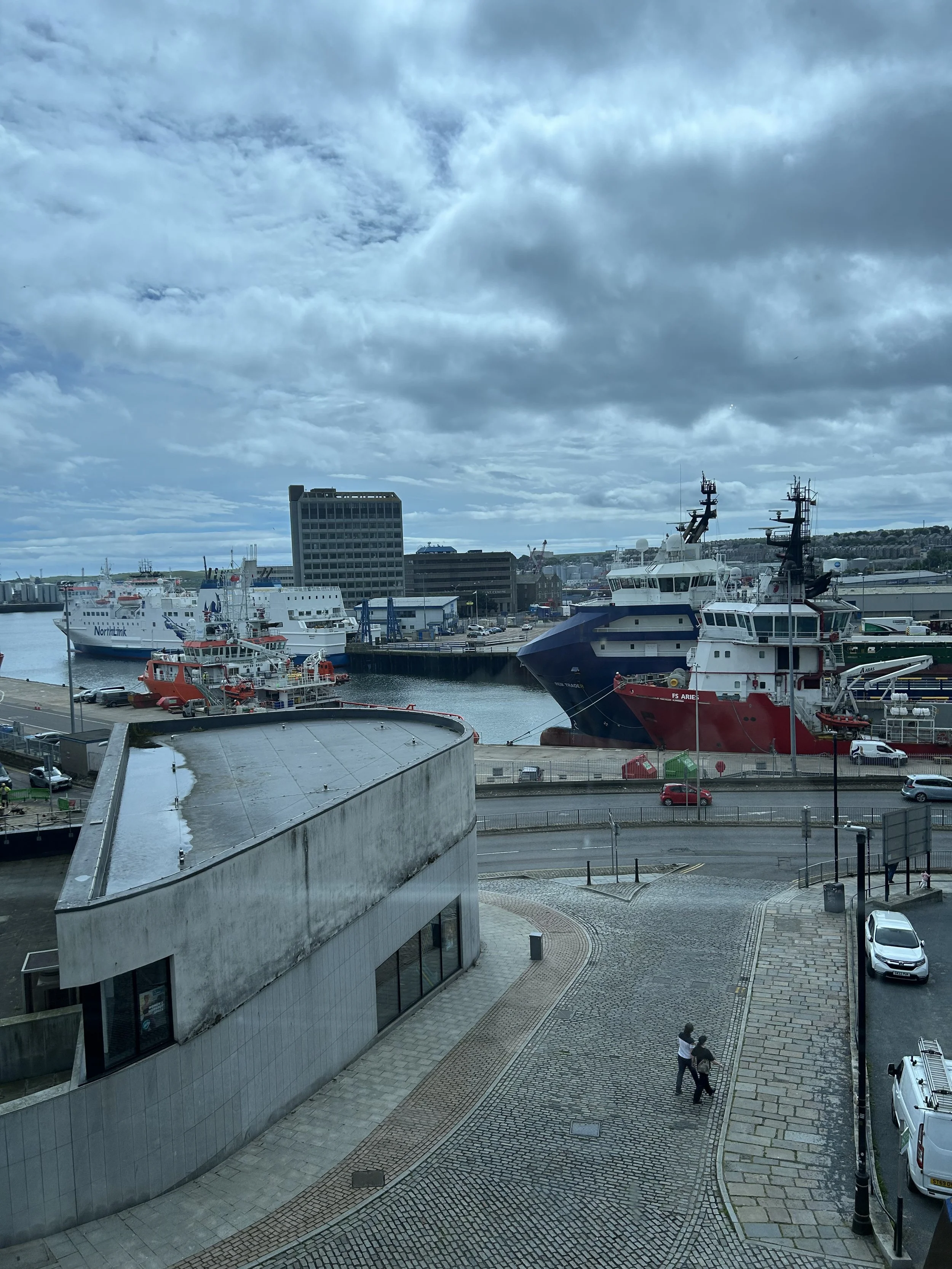
The next day (6/19) we did some sightseeing around Aberdeen, an ancient city of gray granite, its port founded in 1136. Its long and multiple histories of maritime ventures—shipbuilding, empire, trade, the discovery and drilling for oil in the North Sea and then the decommissioning/dismantling of the big oil rigs as oil is wearing down, servicing wind turbines, and rescue missions—all told in The Aberdeen Maritime Museum
Next, we walked to Provost Skene’s House that was more about people who contributed to Aberdeen than Provost Skene or the house itself. Afterwards we wandered into the Art Gallery that showcased Scots artists, like Sir George Reid, whose home-turned-museum we would visit on our return. But by this time, I was getting worn out with the walking; carrying my backpack tired out my hips, my legs, my left armpit. We had dropped our suitcases at the ferry terminal and carried overnight necessities in our backpacks thinking (erroneously) that we would not have access to our bags while on the ferry.
So, we had a nice lunch and then boarded the North Link ferry, settled in, got dinner and wine for the overnight trip to Lerwick. The ferry is a gigantic operation that accommodates people who drive their cars onto the vessel and others like us who are walk-ons. There are lounge chairs, sleeping pods, and individual cabins to rent. The ship has restaurants, bars, and a small movie lounge. Wally joined other folks at one bar to watch Scotland play in an early match of the Soccer World Cup. It turns out our guide was also one of the group cheering on Scotland.
Overnighting on the ferry was quite comfortable for us since we got a small cabin, but two of our hiking group rented lounge chairs and suffered from the cold and beaming lights. For their return, they purchased sleeping bags and found couches in one of the common areas to bed down.
Arrived in Lerwick (6/20). We met our Wilderness Scotland group: Douglas, our guide; Riana and Fran from South Africa, Helene from Zurich, and Therese from Australia. We made quite an eclectic group. Everyone proved to be more experienced and adept at wilderness hiking than we, regaling us with stories of their other adventures, hiking Mt. Kilimanjaro, black tubing, hiking the outback of Australia, trekking through Switzerland and Scotland.
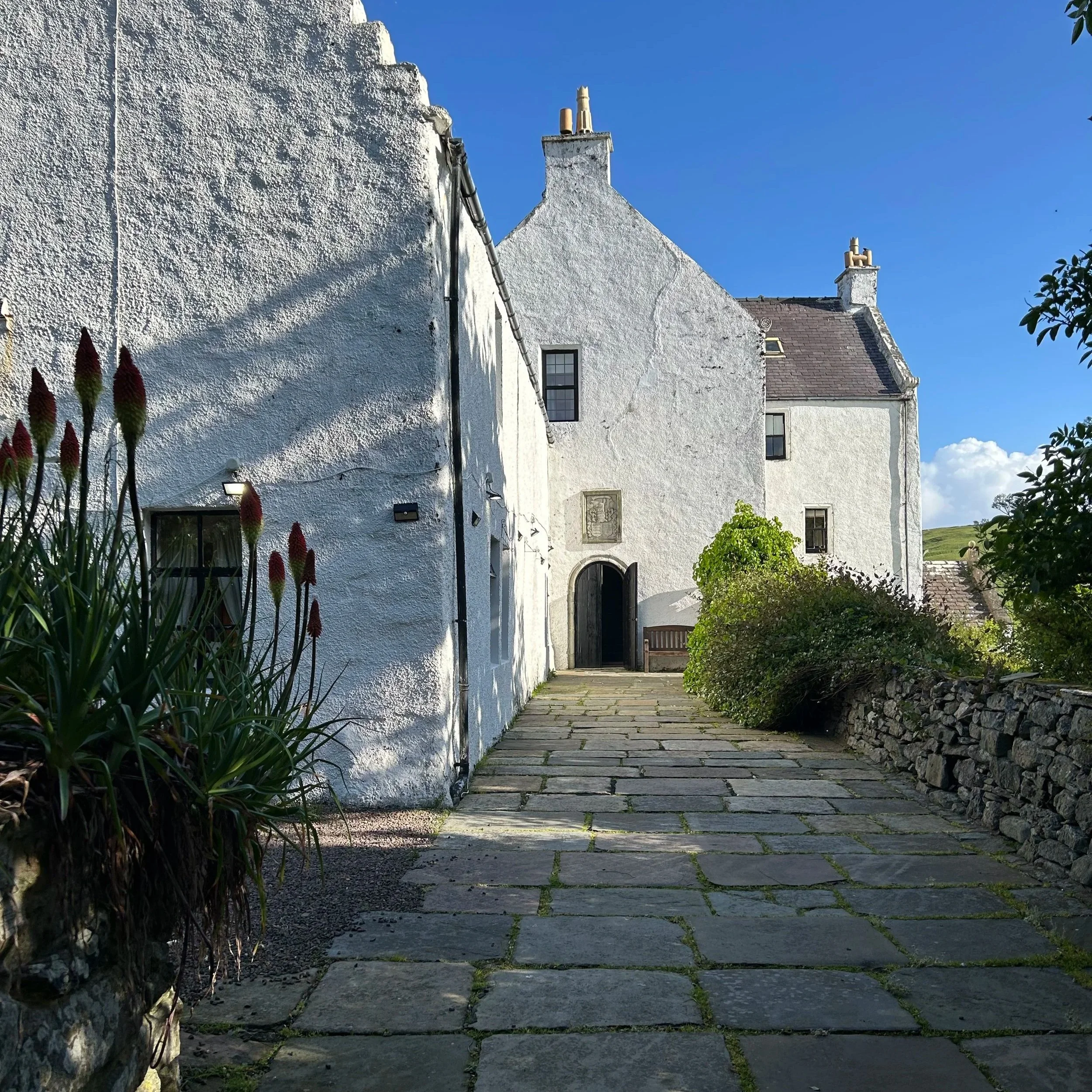
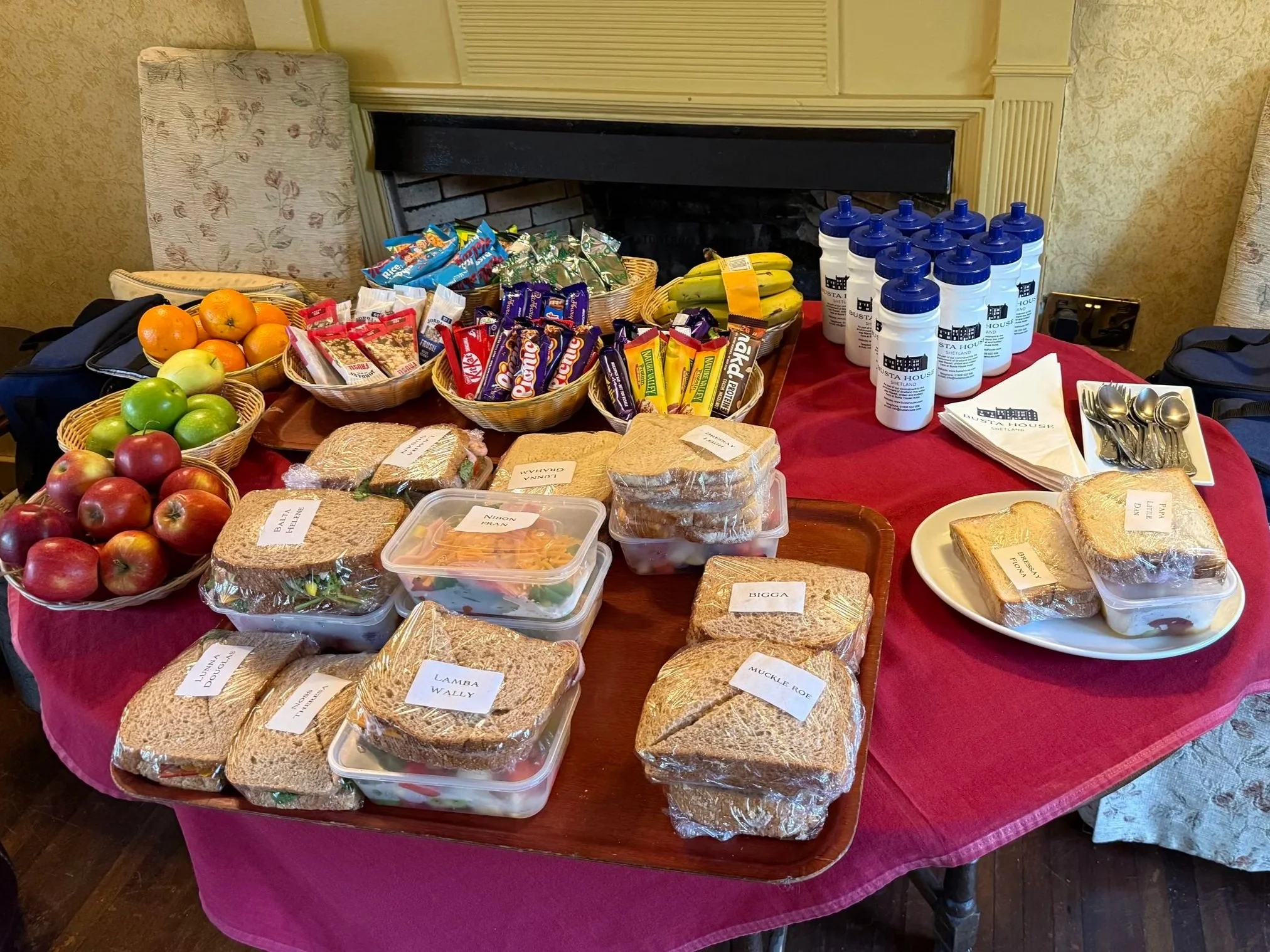
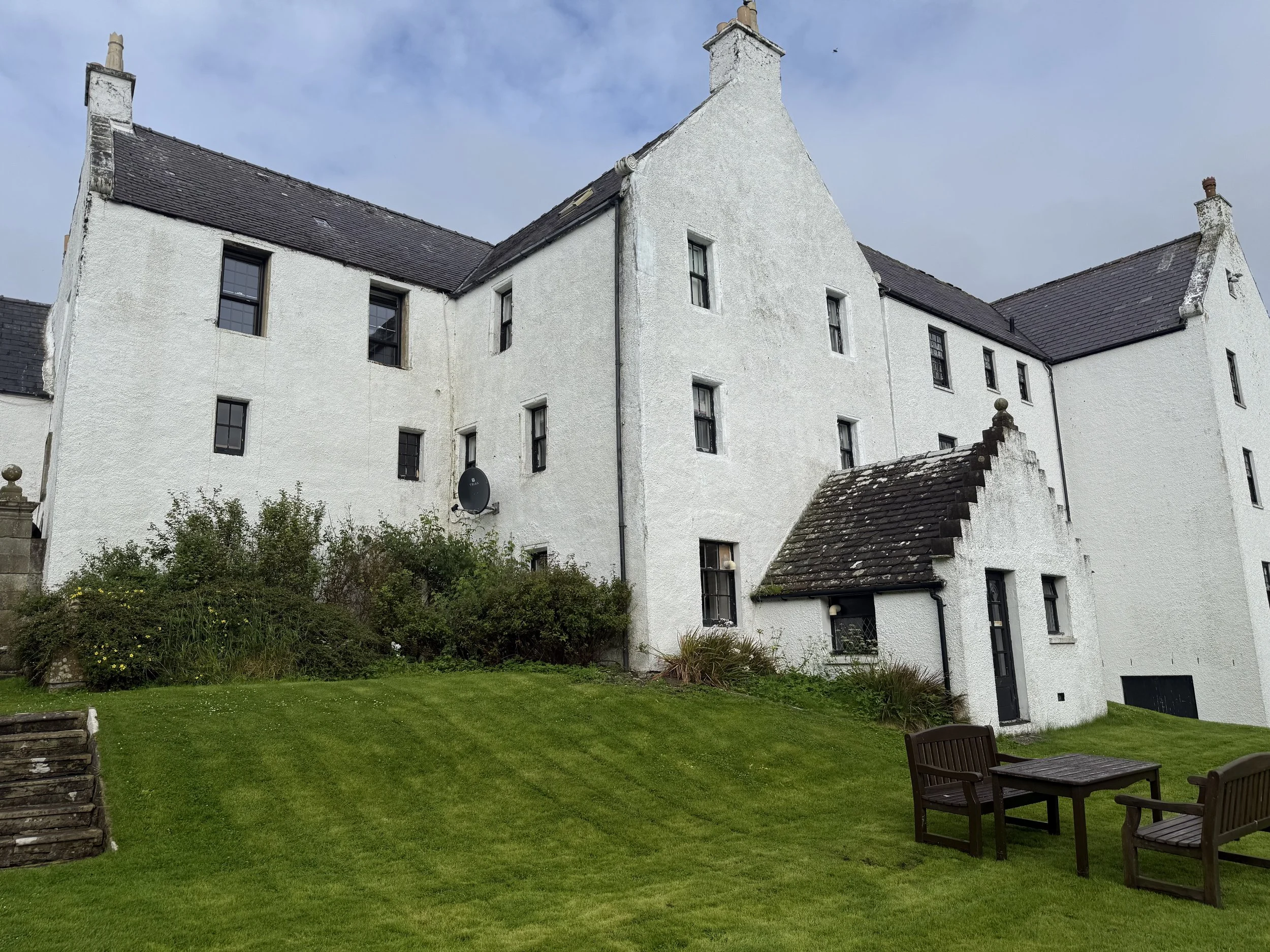
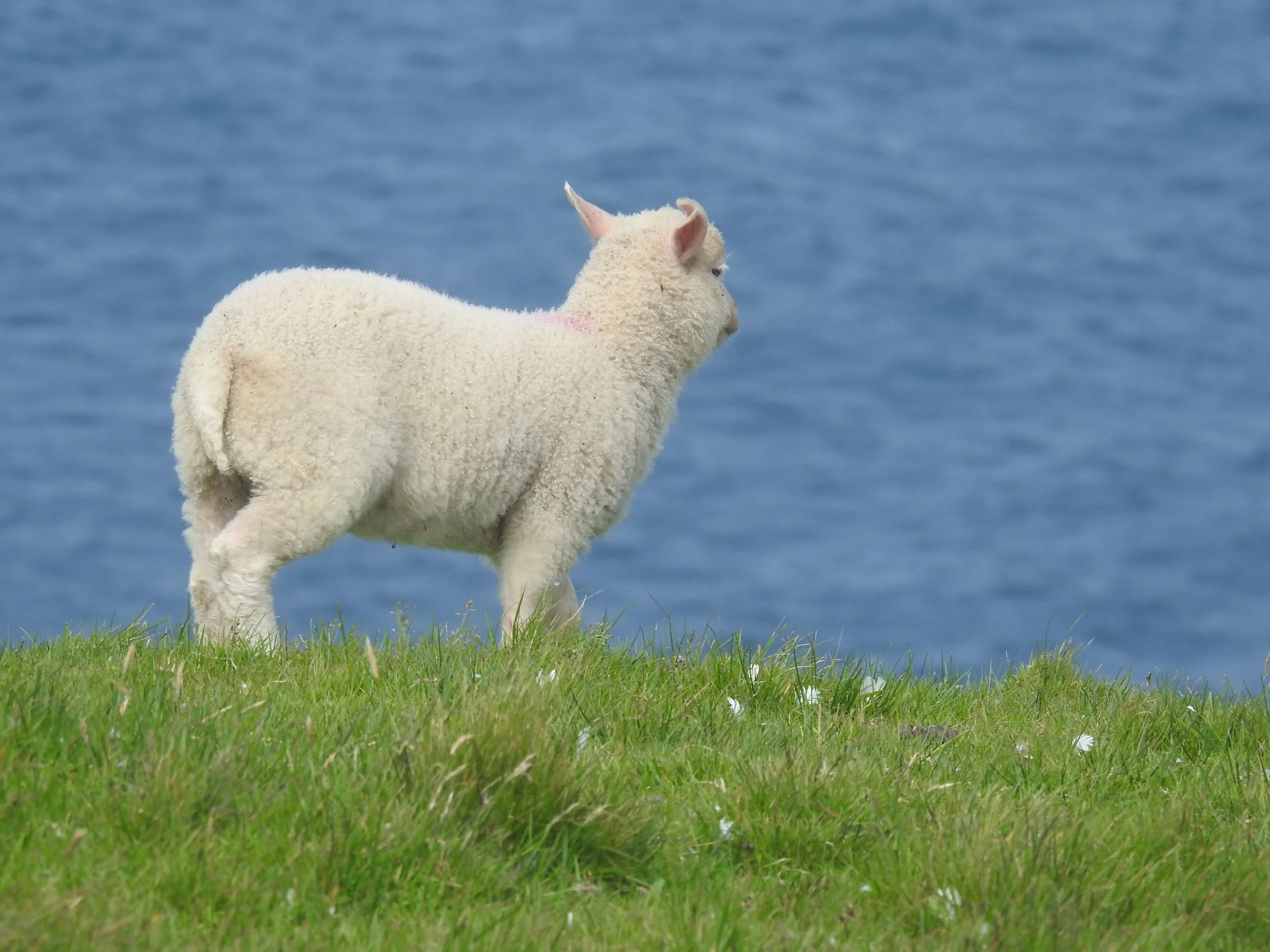
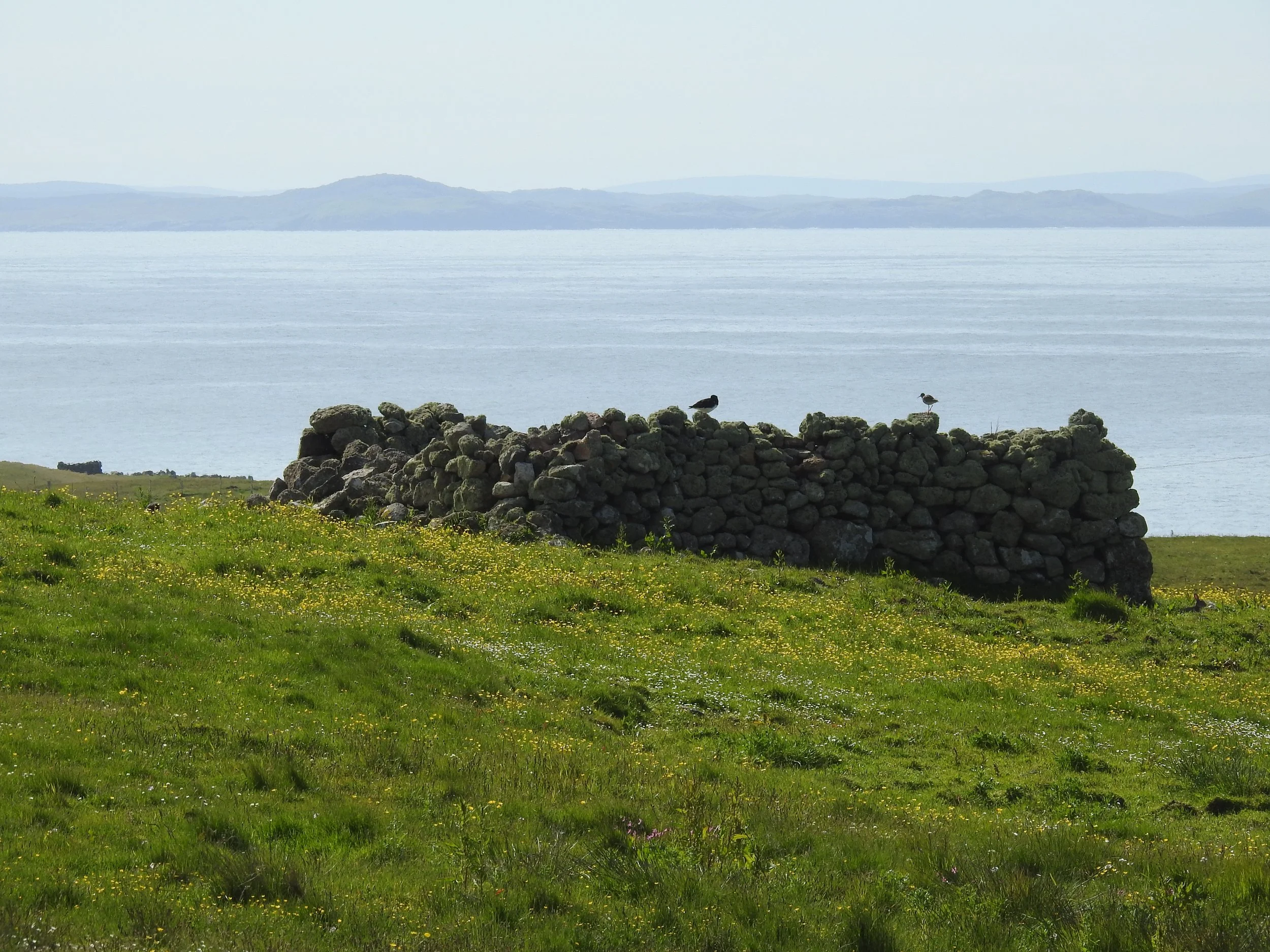
After checking in at the Busta House and grabbing sandwich lunches, we were off for our first hike—6.9 miles of birdwatching. Therese was keen to identify birds and add them to her life list, Helene attended to flora, Doug pointed out birds and flowers to us, telling their stories. Almost everywhere we walked, bits of abandoned stone houses and sheep and sheep poo turned wilderness into landscape, the persistent “baa” a melancholy tone as lambs looked for their mamas.
My God! The walking was rough at times, following narrow, rocky paths up and down hills, winds gusting so fiercely that twice I fell over, my knees, my ankles in pain—how I wished we had actually trained for this journey. Doug was good at checking on me and gave me another walking stick to help me keep my feet. I worried about the strenuousness of the walk on Wally, but he took numerous stops to take pictures. In this and all of our hikes, we were the stragglers, bringing up the rear.
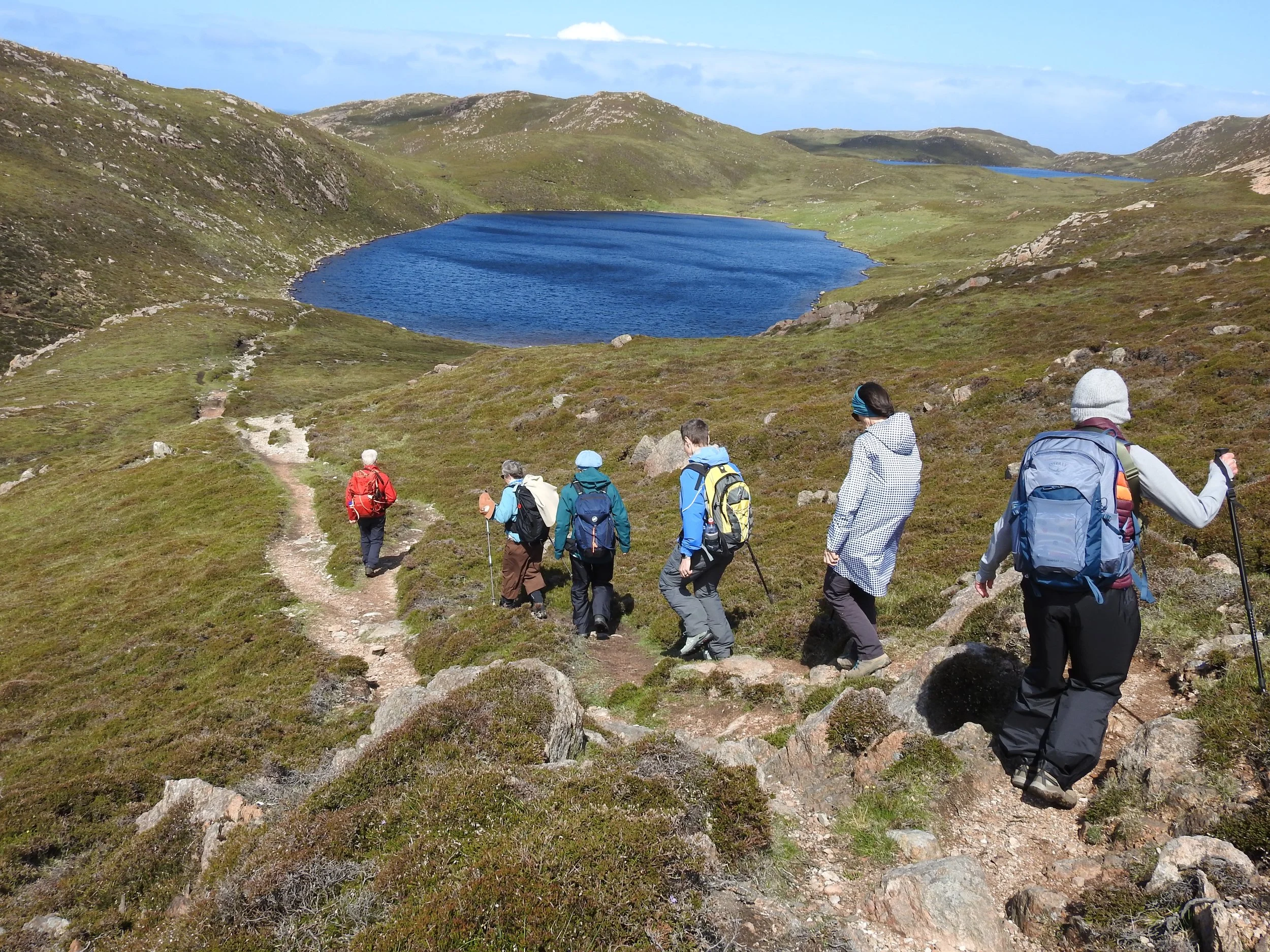
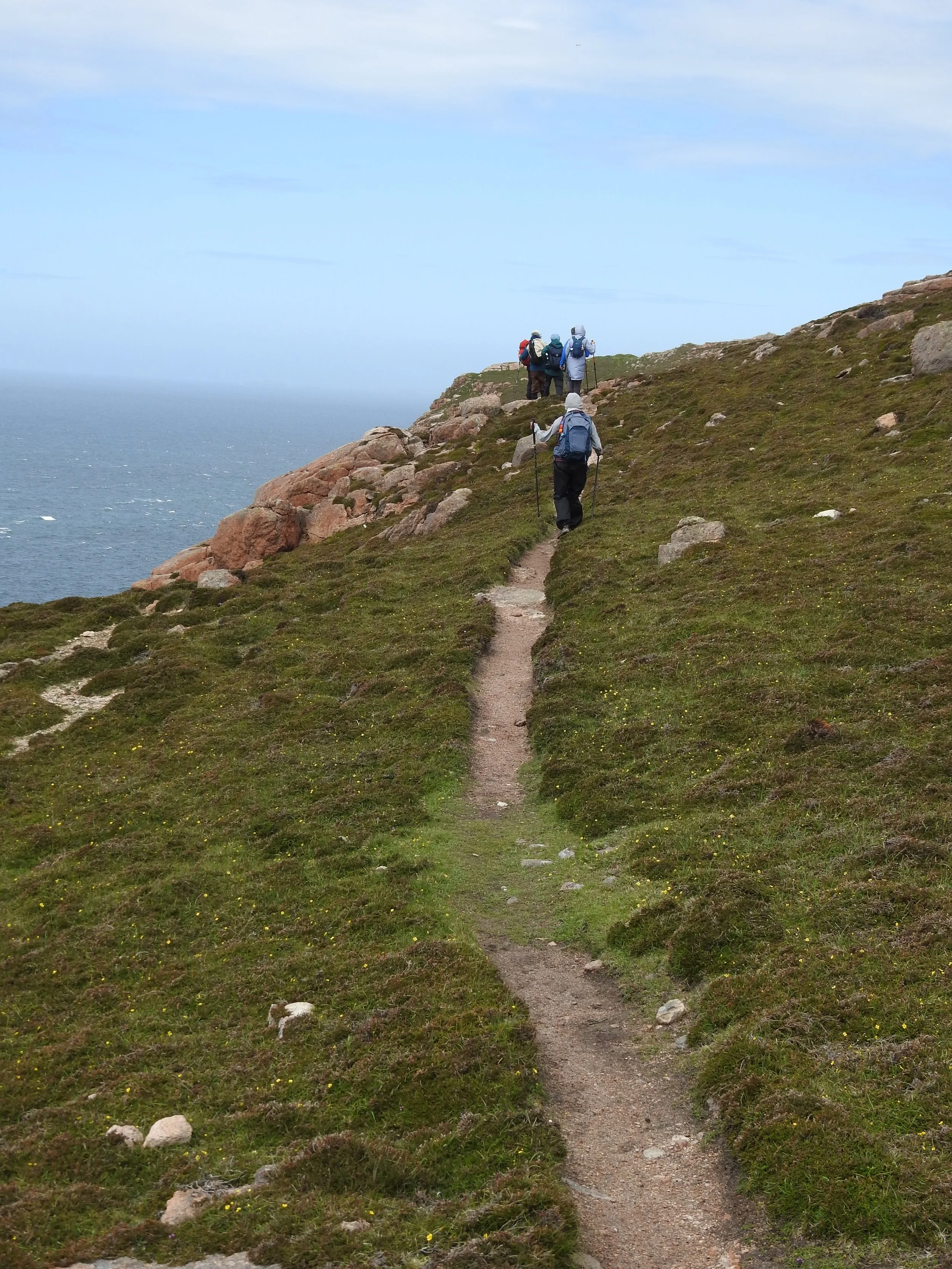
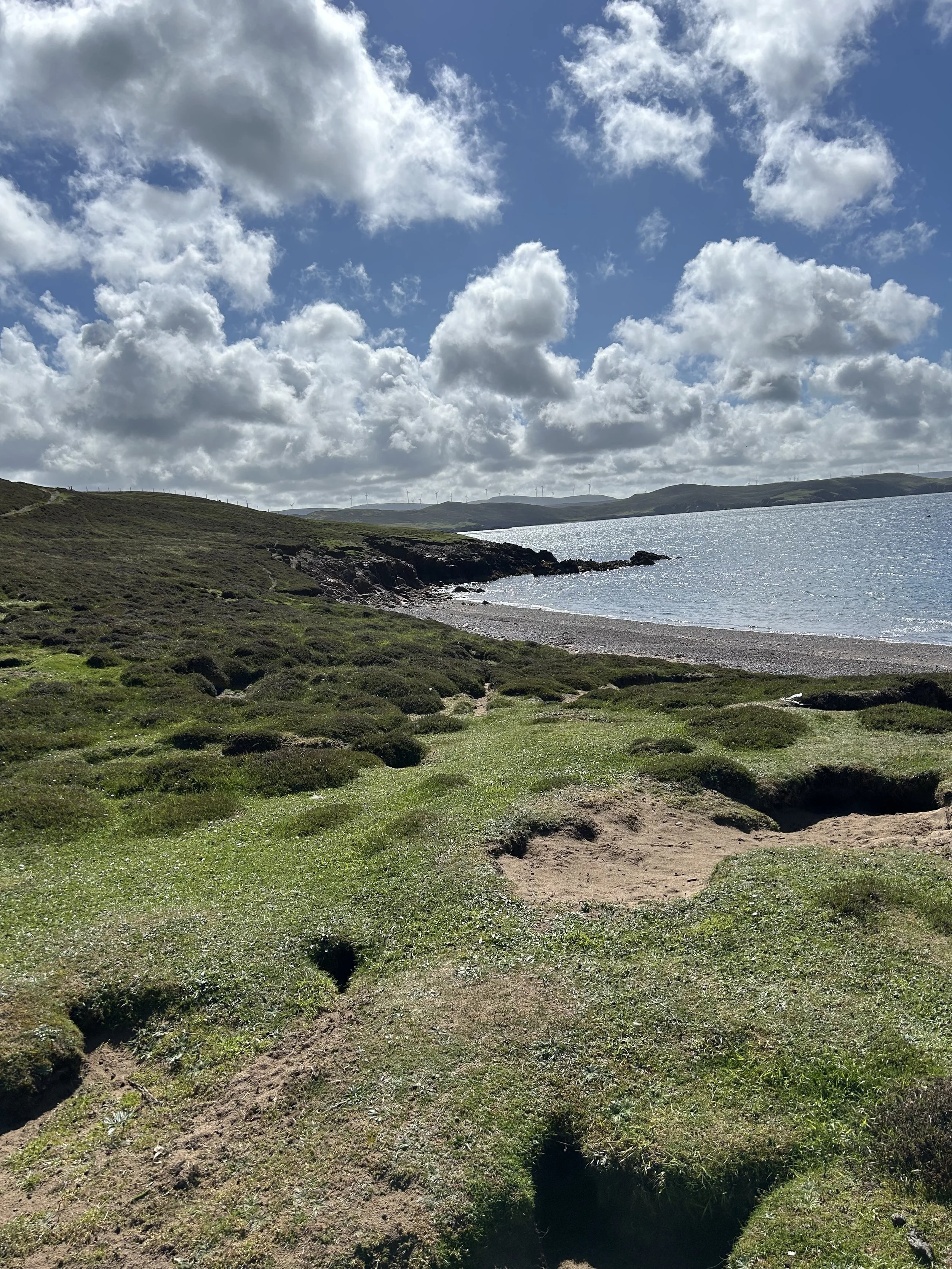
But beautiful scenery, a clear day.
Back at Busta House, a nap and then a shower—legs wobbly, I slipped in the shower, hit my head trying to figure out how to turn on the hot water. I had to call Wally to get the water right. How ignominious it would be to fall and injure myself in the shower! Luckily, just a slight bump on my forehead.
At the end of the evening, we had a lovely dinner at Busta House—I had half-plates of poached pear, salmon, salad. Each morning, they served continental and Scottish breakfasts (eggs, bacon [aka ham], sausage, beans, mushrooms, tomatoes, haggis); for lunch they fixed a variety of sandwiches—cheese, egg salad, salmon; and for dinner they had a menu of local foods to choose from. I pretty much worked my way through the menu, trying mackerel paté, salmon gravlax, lamb with sauce, white fish with red pepper sauce, and desserts—toffee pudding, crumble, ice cream. Wally even tried a Lerwick IPA.
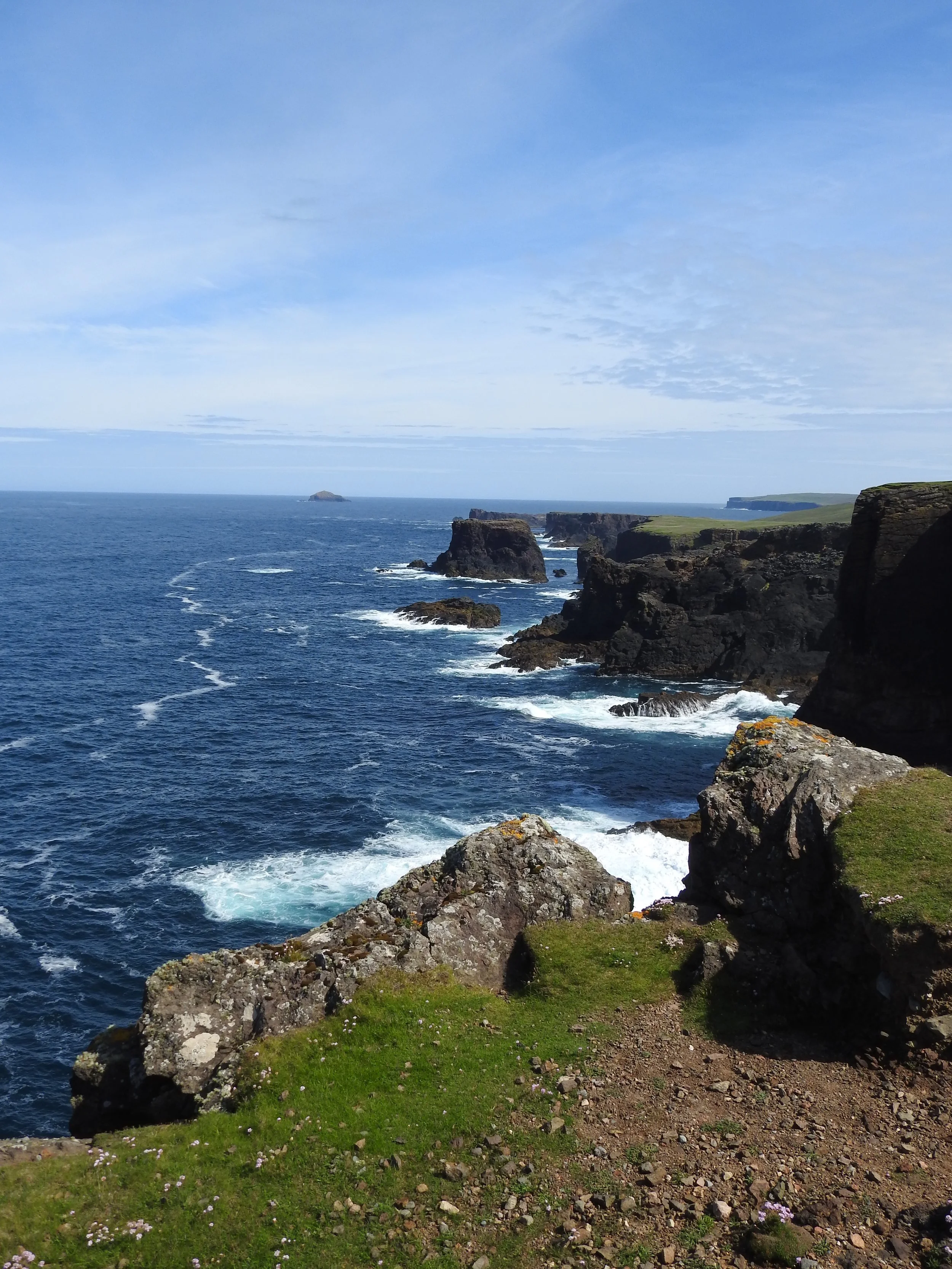
Throughout our wilderness adventures in Shetland, at Muckle Roe, Eshna Ness Cliffs, the Hermaness NNR, and Sumburgh RSPB Nature Reserve, we met the greatness of sea and sky and cliff and the dainty tenaciousness of the plants and the little creatures that share space with the omnipresent sheep. The great, majestic sights of nature—the sea expanding out to the edge of infinity and crashing on the shore—the ragged cliffs, bouldered and slabbed by time, the incessant ebb and flow of the tide outside of time, measuring time itself. The seemingly barren hills, rolling and rolling to the sea, the wide sky, blue with scatterings of cloud; and the wind, blowing ever, whipping my hair, whipping the small things to cling to the earth, whipping me off balance. And the cliffs—the precipitous drops to the sea and ragged rocks—the dangerous but inspiring heights, the birdwatchers in our group hovering over cliff edges to get a look and pictures or birds, mainly the puffins they seemed obsessed with.
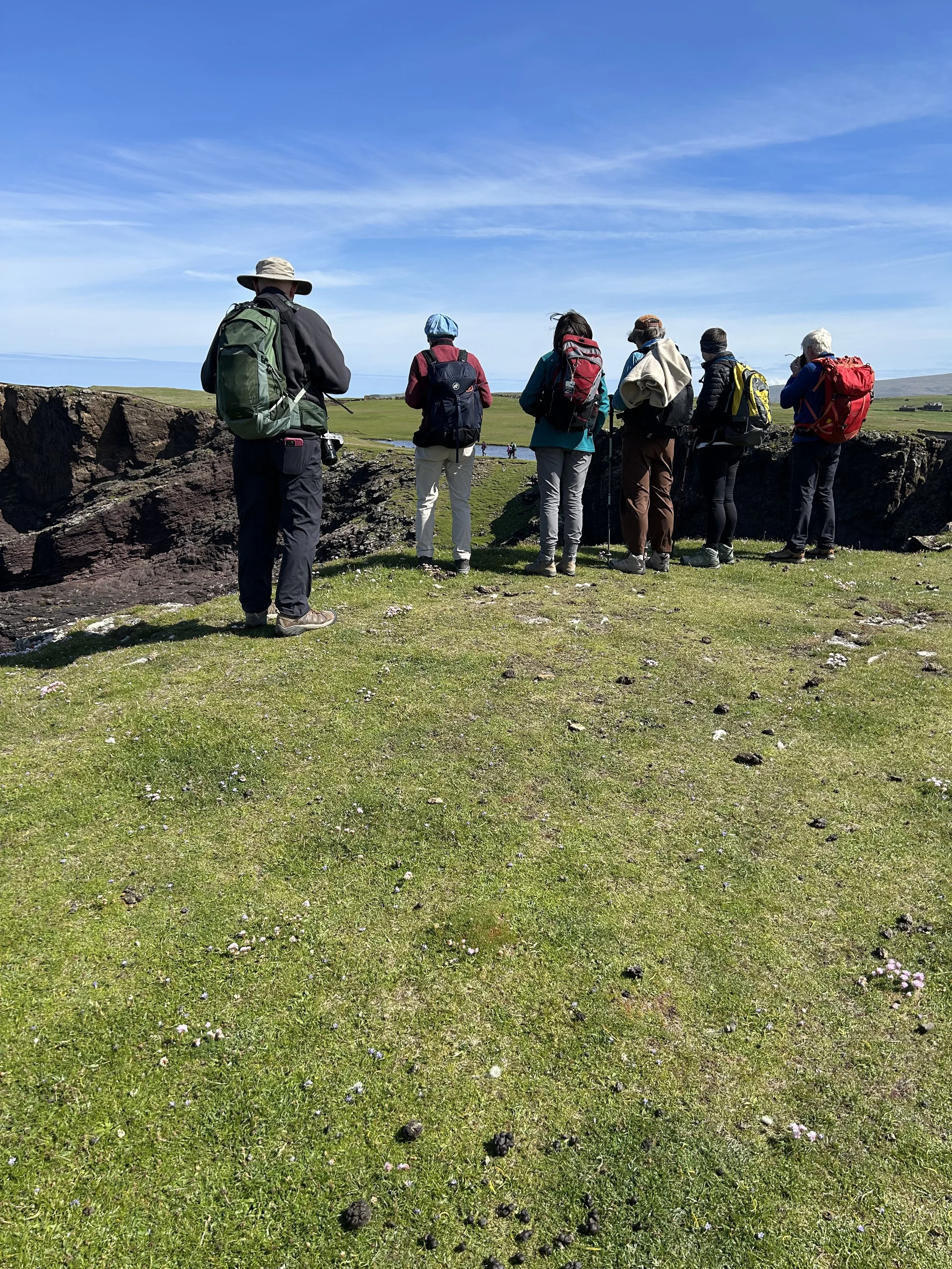
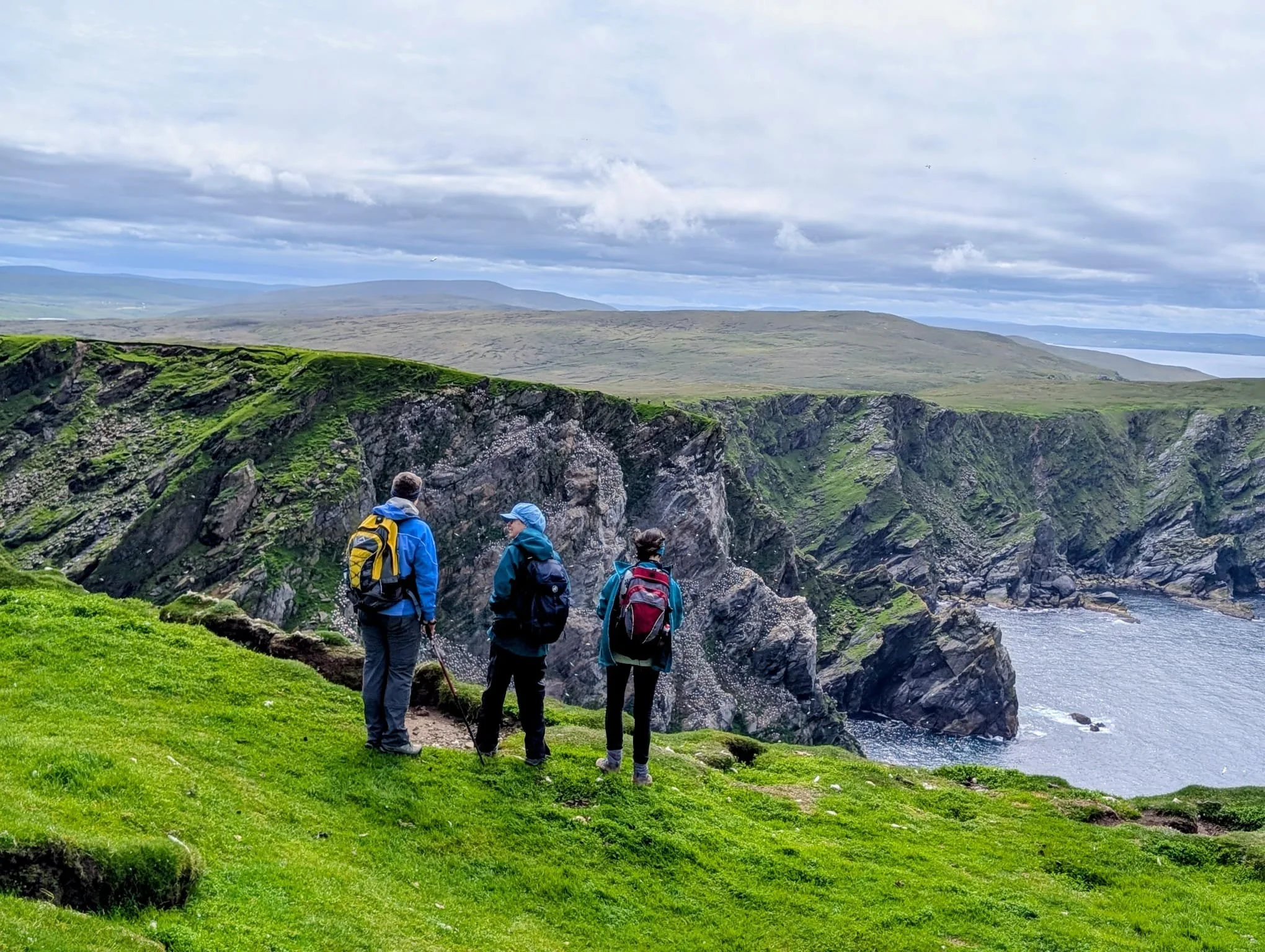
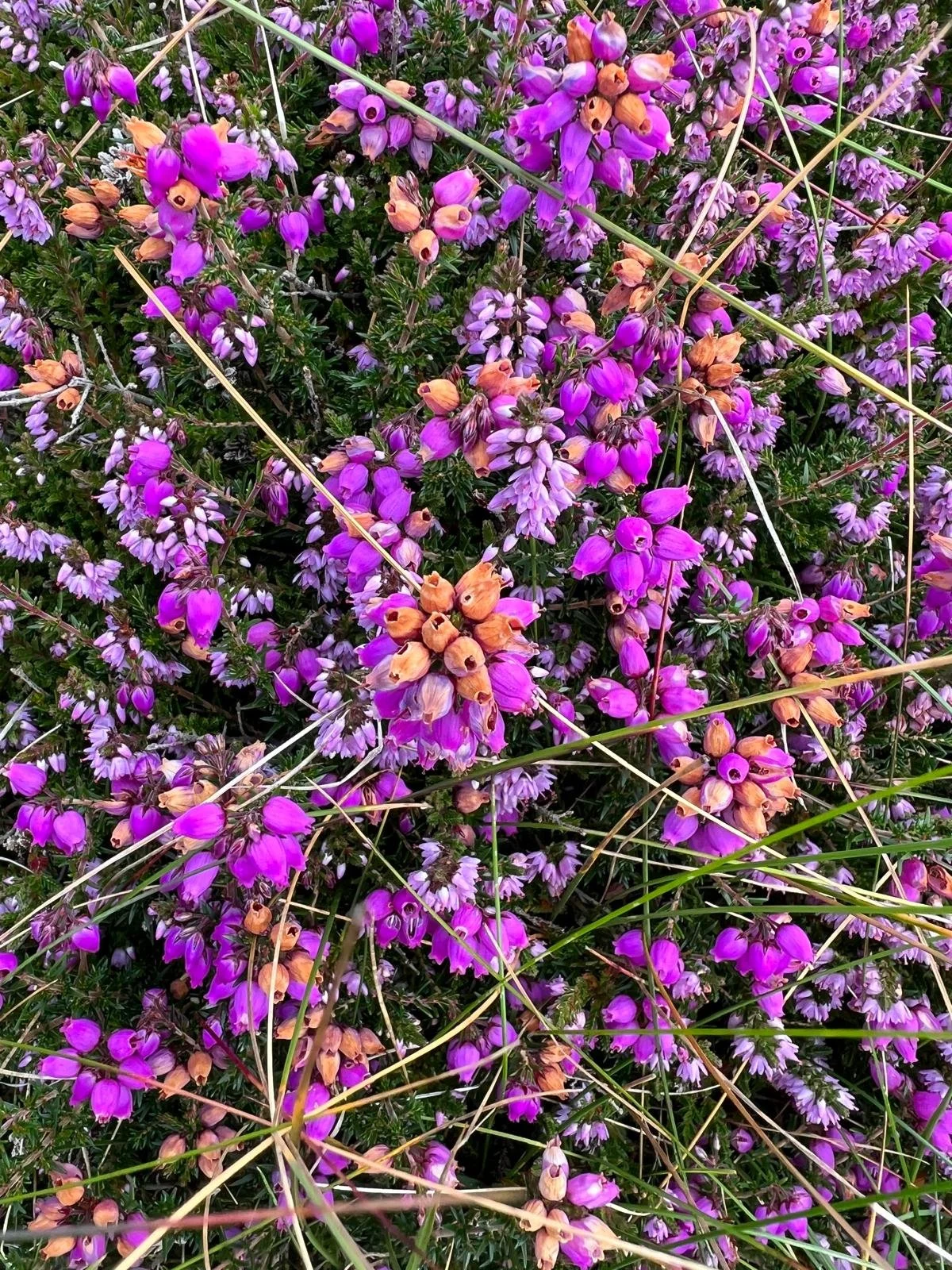
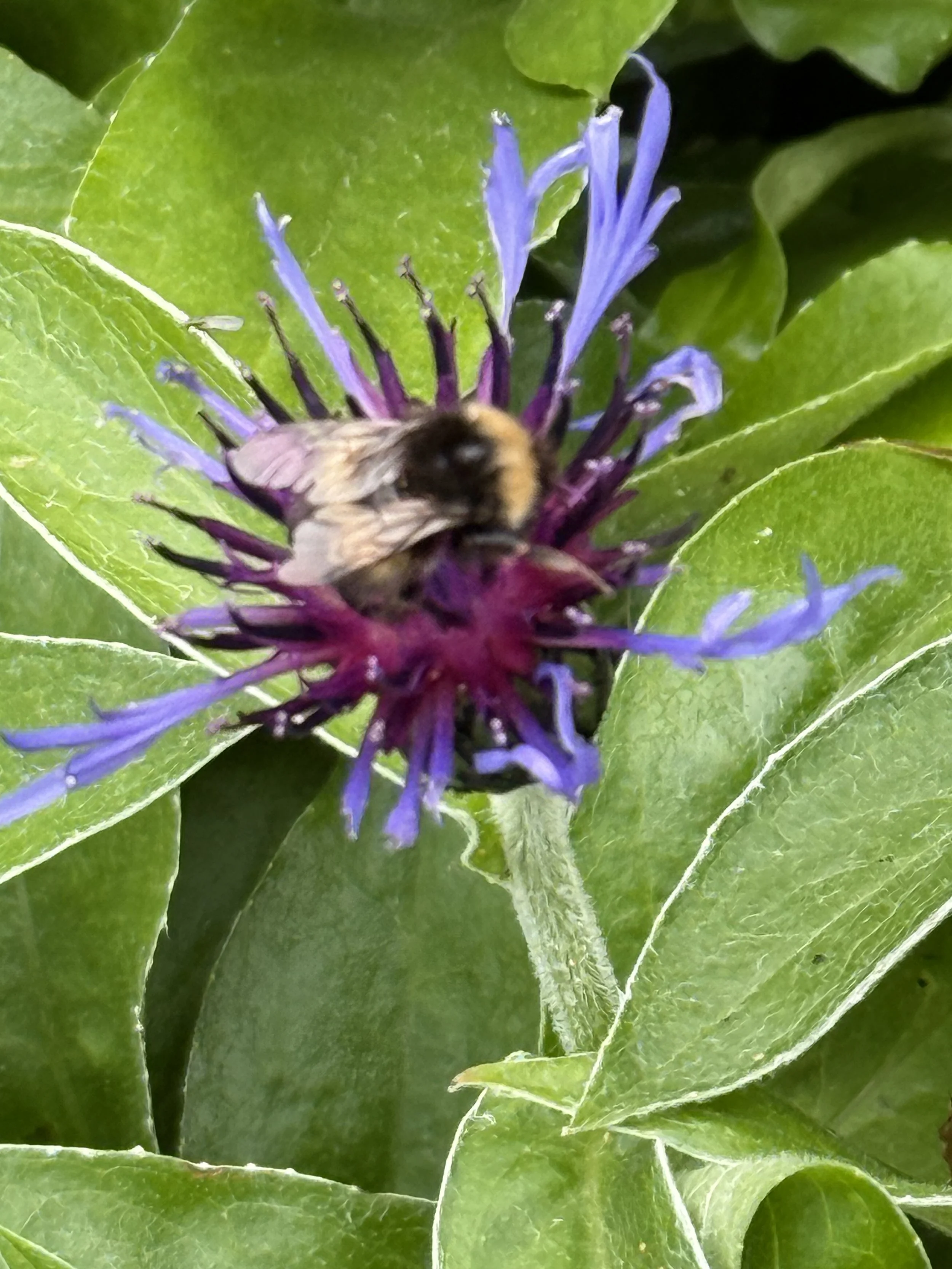
All this grandness of space and time juxtaposed with the dainty—not fragile because hardy enough to survive in this climate, but small, clinging to the earth—the flowers that blanket the earth, the orange and black Shetland bee, the butterfly similarly striped and colored—reminded me of the desert landscape, harsh, but the small things have learned how to adapt and survive. The birds, kittiwakes, puffins, and gulls and gannets, that find niches on the rockface overlooking the sea to breed and raise their young until they fledge, the rabbits that burrow into the sand hills of St. Ninian and frolic under cover of the low-growing plant life—the melancholy, incessant “baa” of the lambs looking for mamas.
Ever the interplay of grand/majestic and dainty/young, the resilience of power and of persistence, the power of resilience and persistence.
6/22, A gloriously beautiful day. We had a quick stop at Islesburgh, a narrow bit of land between the Atlantic Ocean and Sullom Voe, where old time travelers could walk their boats across from one body of water to the next. Geologically interesting. Saw some stacks of rock with arches and shapes out in the ocean. My friend Cathy who took a BS in Geology to go with her PhD in literature would have loved the geological history of Shetland.
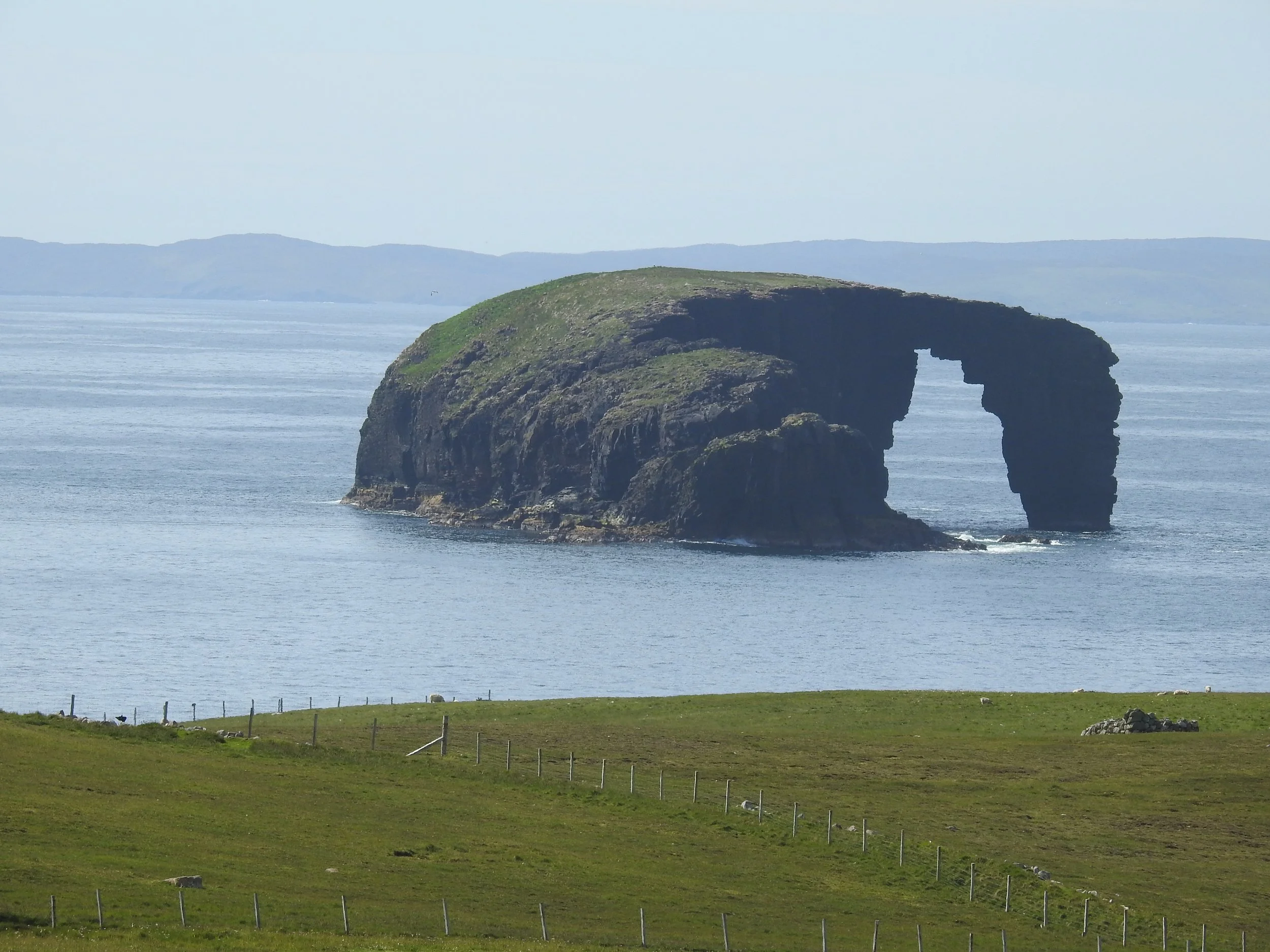
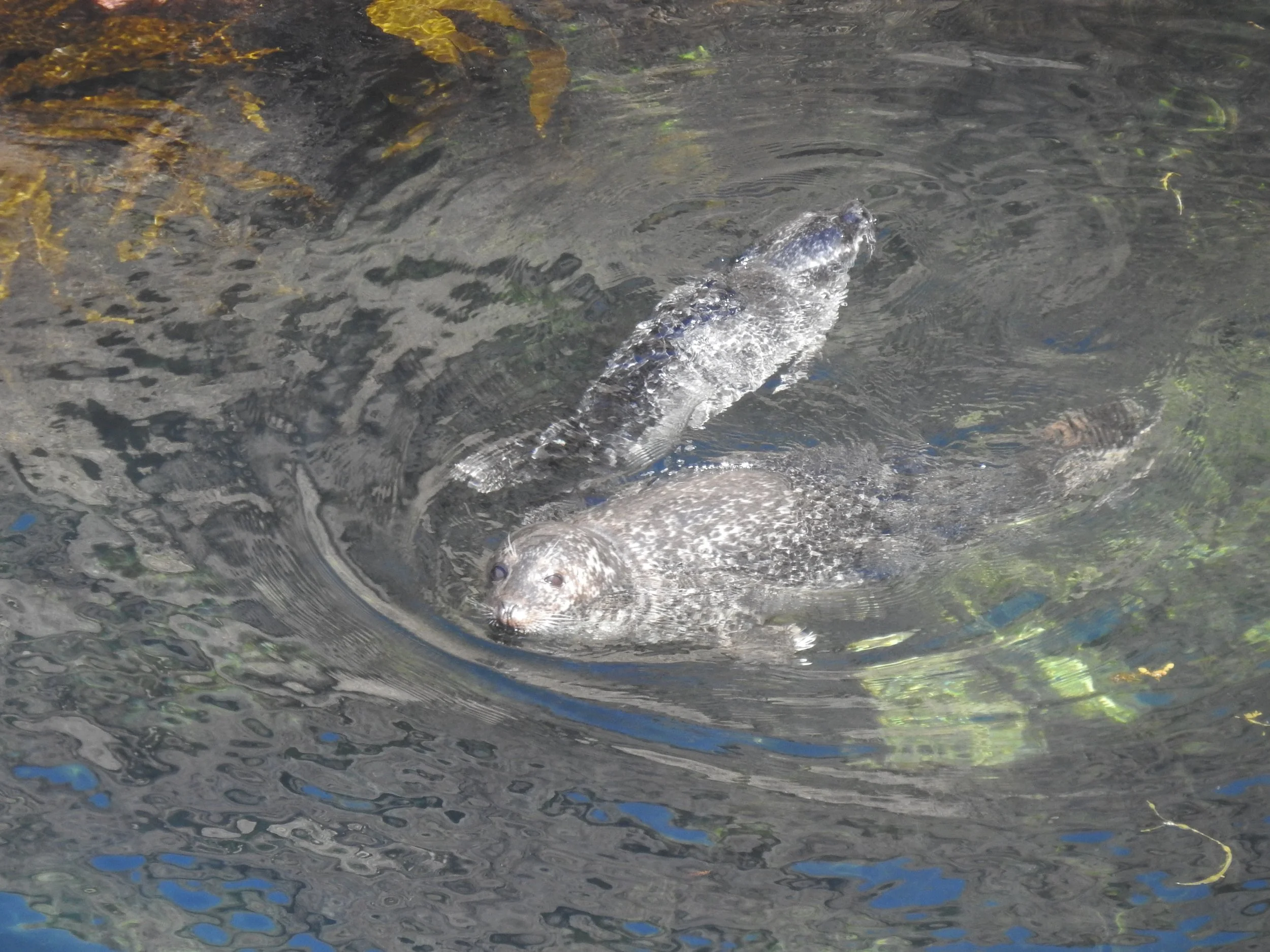
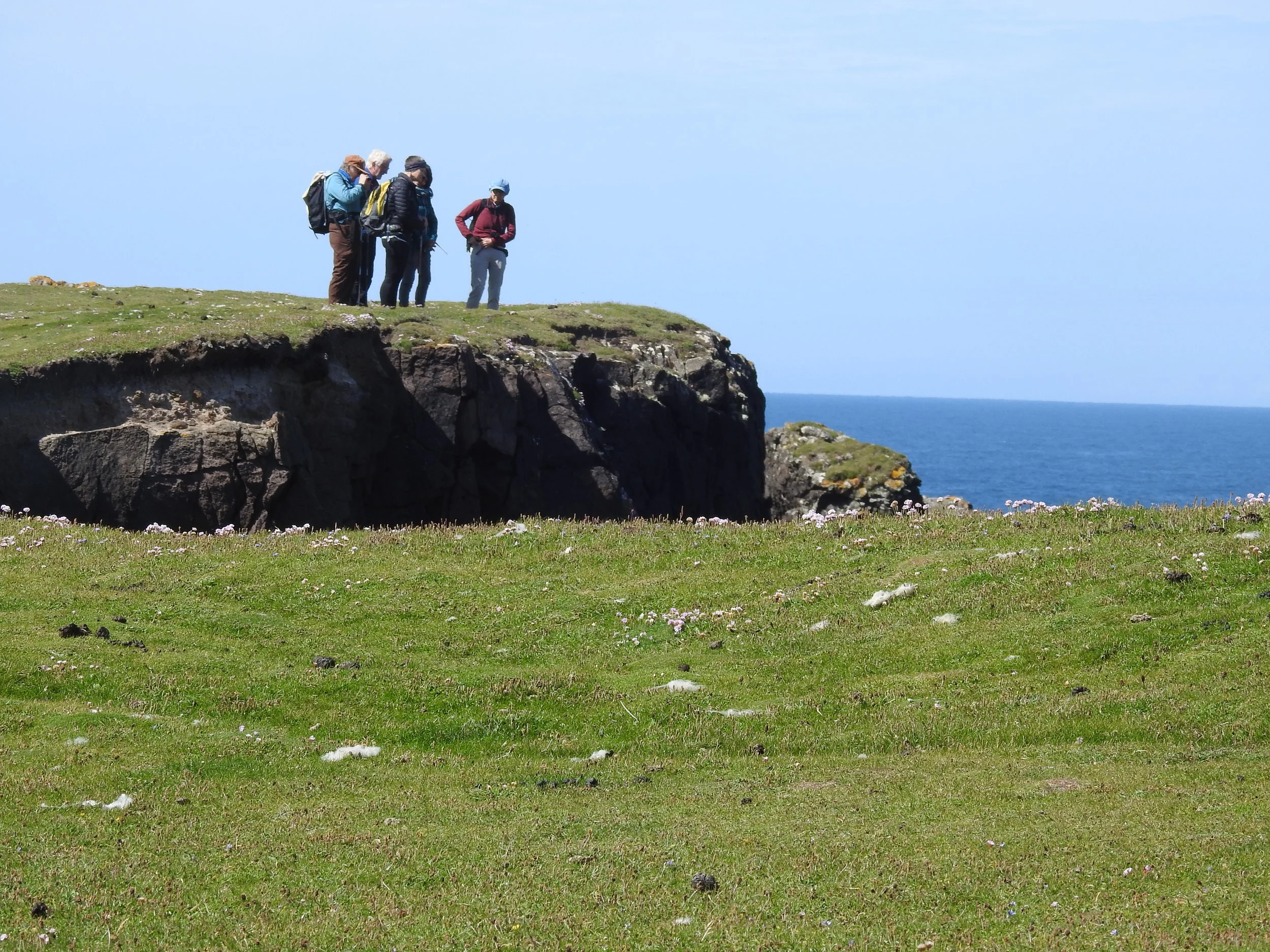
Then to Tangwick and the volcanic cliffs that edge the land, kin to the craggy cliffs of Maine formed in the same upheavals of heat and rock. The rest of the group peered over the edge of the cliffs, watching flying and roosting birds, a mother seal and its pup, the crash of the waves on the giant rocks below. I am uncomfortable near the edges of high places, so I generally stayed back from the edge and tried not to look at Wally taking massive numbers of photos. My hands sweaty, my stomach queasy, the beginnings of a shaky reaction to the heights. It’s like I feel myself physically coming unglued, like the time in the glass elevator going up the Eiffel Tower, mashed against the doors, or when we went to the Grand Canyon and young brothers and later my kids peered over edges while I stayed behind rock fences.
But the day was beautiful, sunny, not too windy. We ate our sack lunches at the ruins of a broch, an Iron Age drystone fortified round house or storage silo. What we witnessed in Shetland was time—not just geologic time, God’s time, but human time. Dotted throughout our hikes, stone ruins, houses hollowed out by time, brochs from an ancient period.
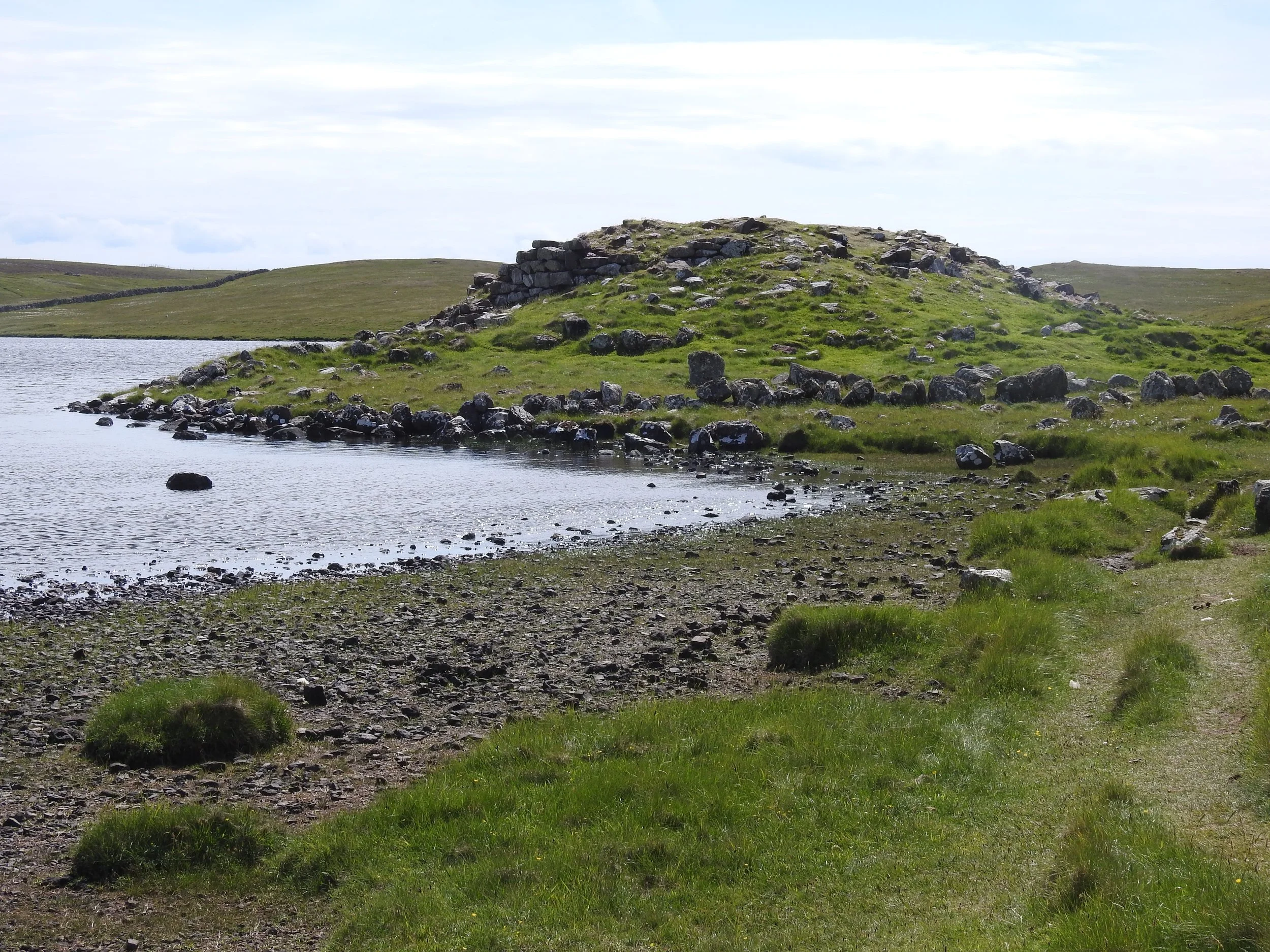
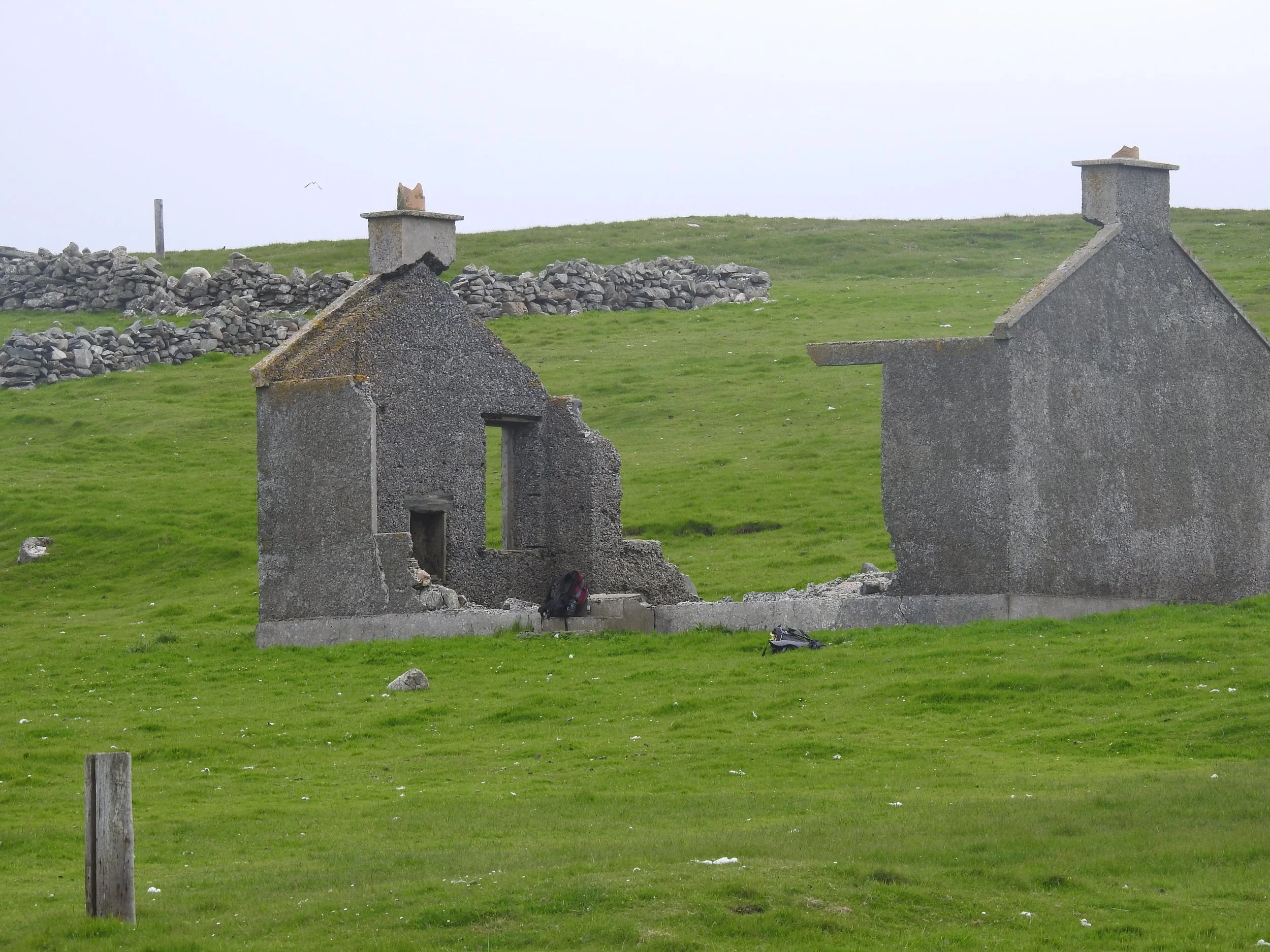
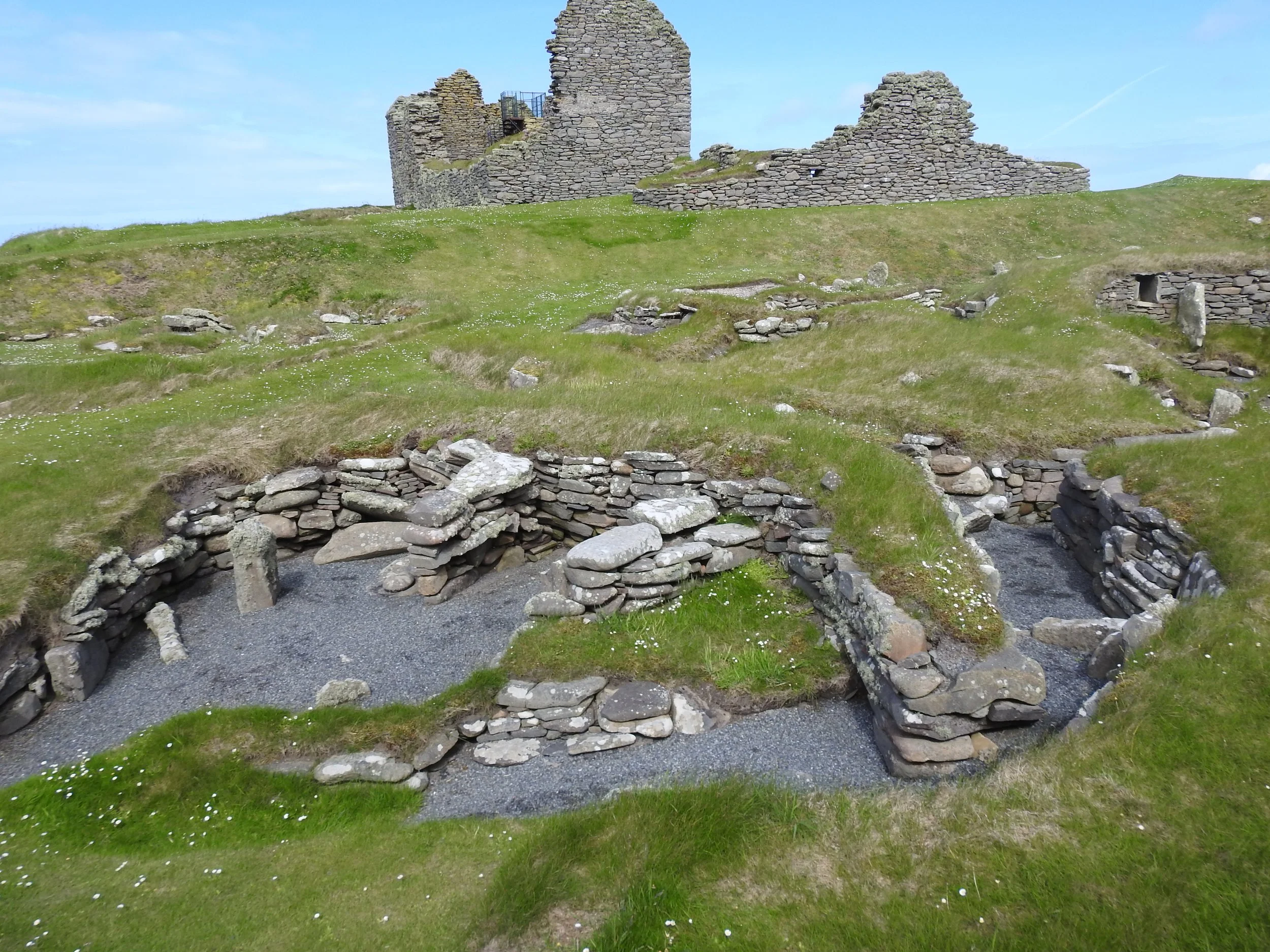
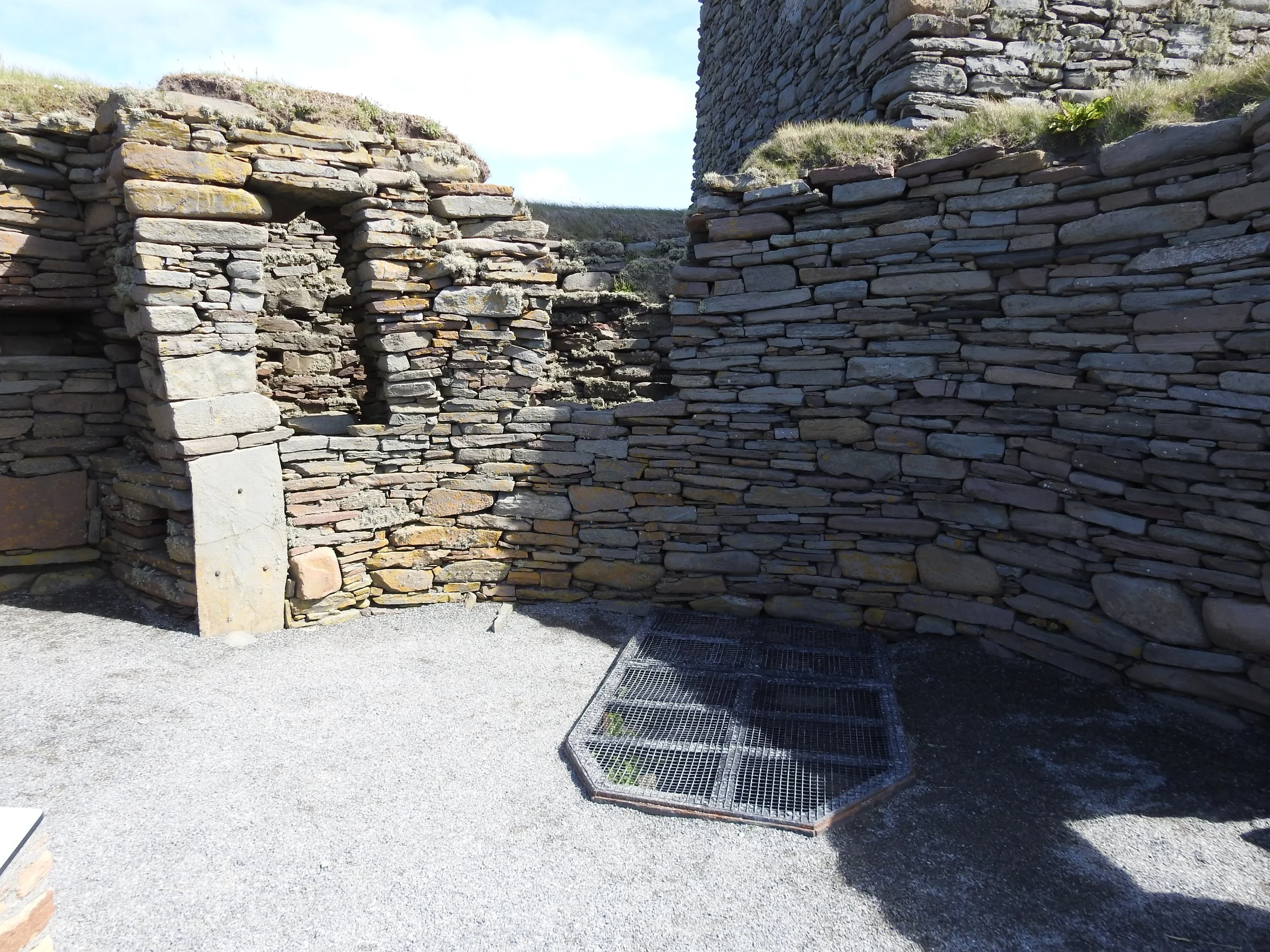
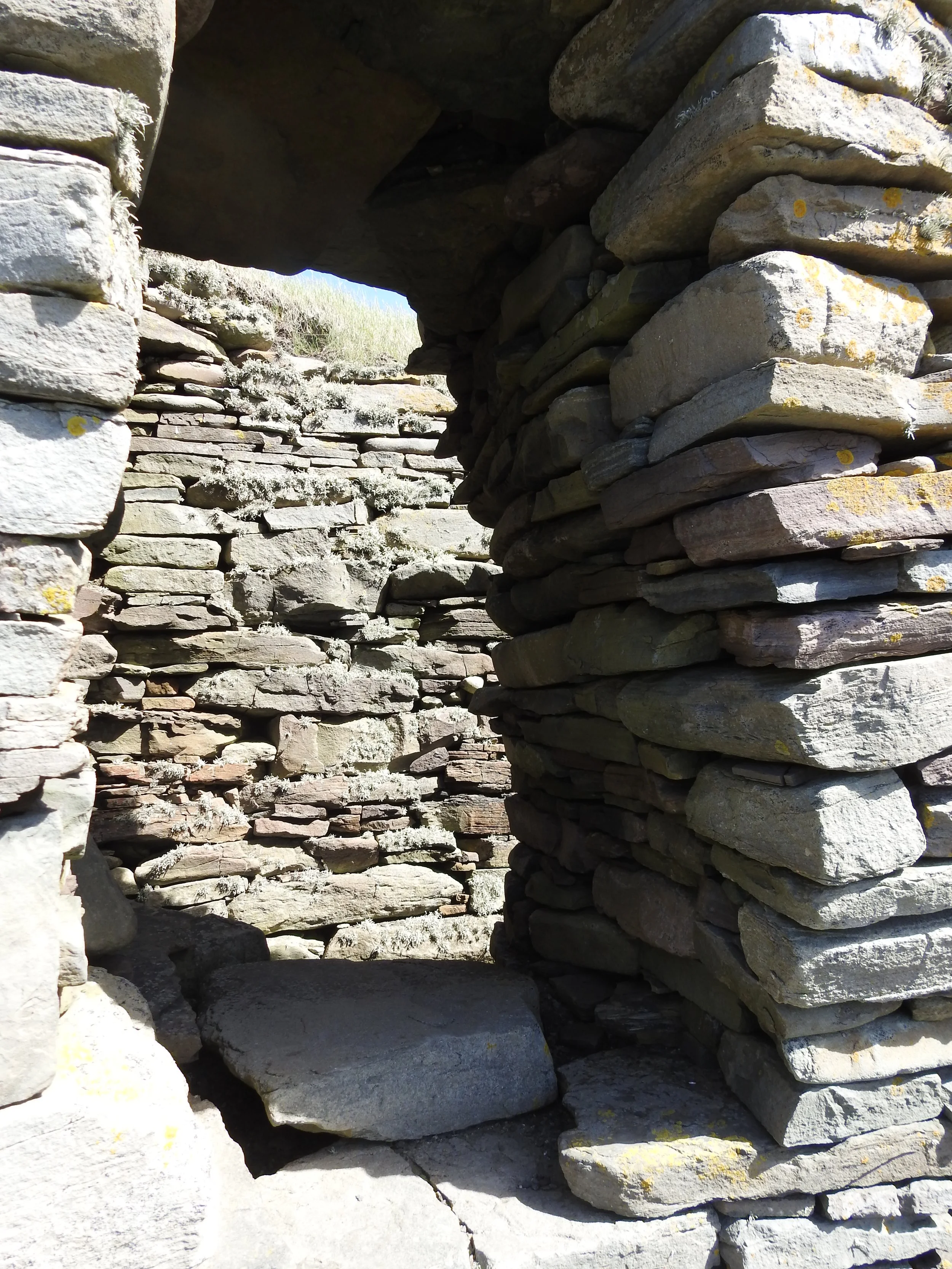
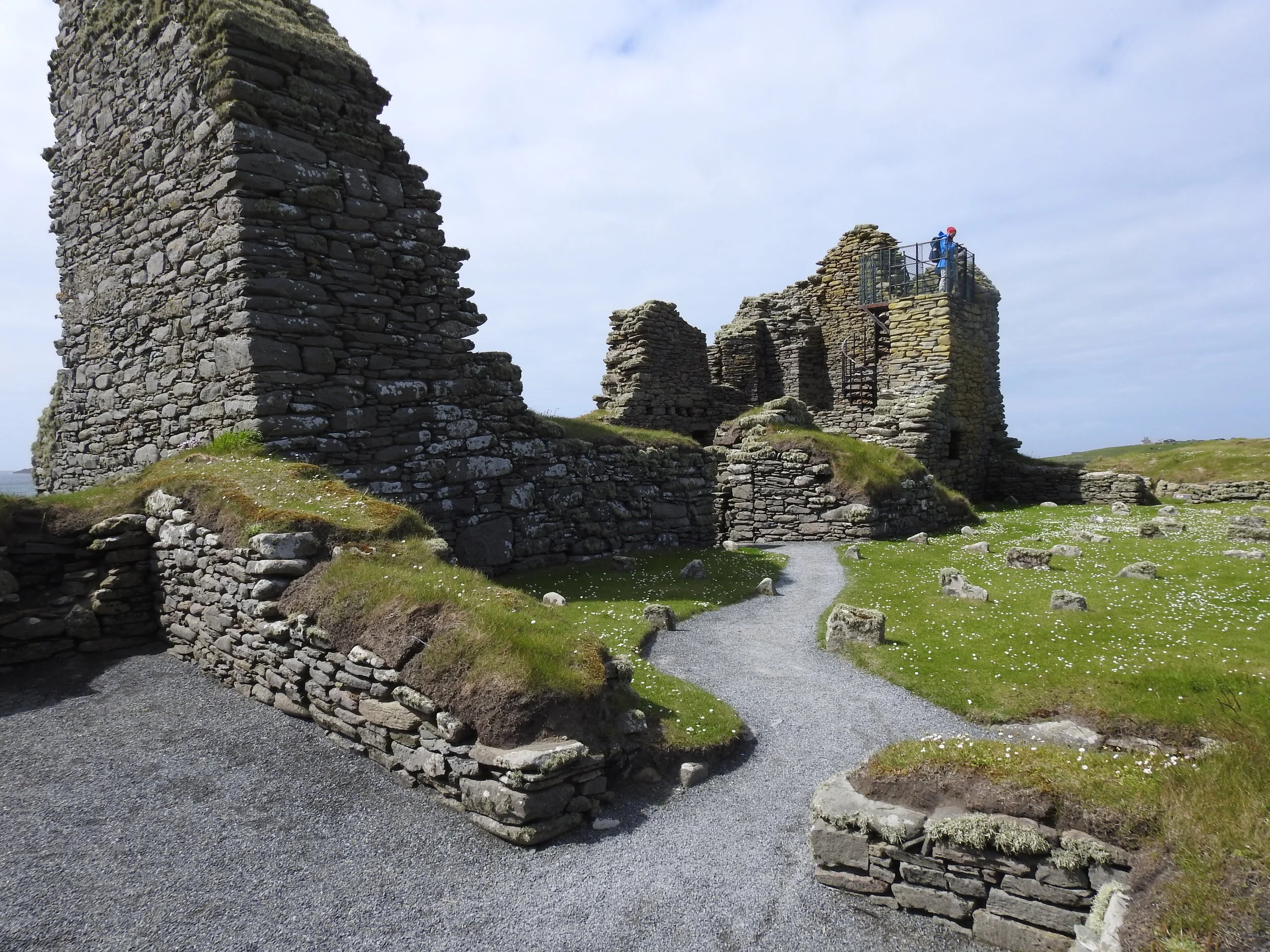
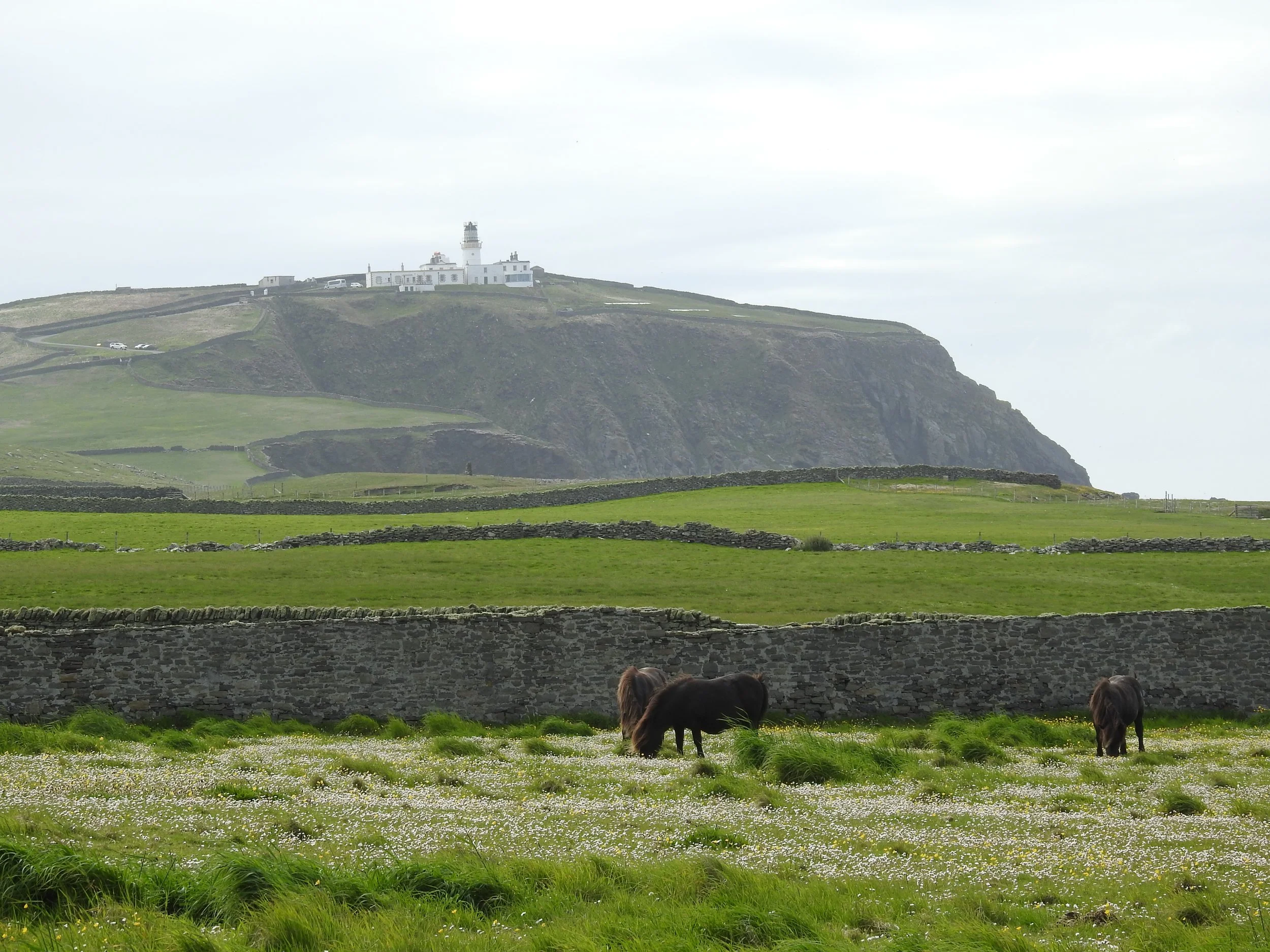
This immensity of time, and the layering of time and building, humanity and culture, on top of and beside each other, struck me when we visited the Jarlshof Prehistoric and Norse Settlement at Sumburgh Head, the southernmost point of Shetland. The archeological digs contain architectural evidence dating back 4000 years, demonstrating changes from indigenous Stone Age and Iron Age builders to Norse settlers to 16th-century lairds, from round stone enclosures to compact rectangular forms, to long houses with storage pits, to the multistoried home with chimneys standing on both ends. Up the hill from the ruins sits a 19th-century lighthouse with a café for visitors, where we enjoyed a cup of tea. At the archeological center, we learned from Bobby, who with a toss of his long dark hair and politely correcting his “boss’s” interpretation of ancient events with his own, local knowledge, announced that “Viking” is not a people, it’s a job. I was struck throughout our hikes by the persistent architecture, where history is part of the landscape and ever-present—ruins sitting next to modern buildings or added onto through the years, the old architectural style, rectangle with chimneys at both ends persisting in modern structures.
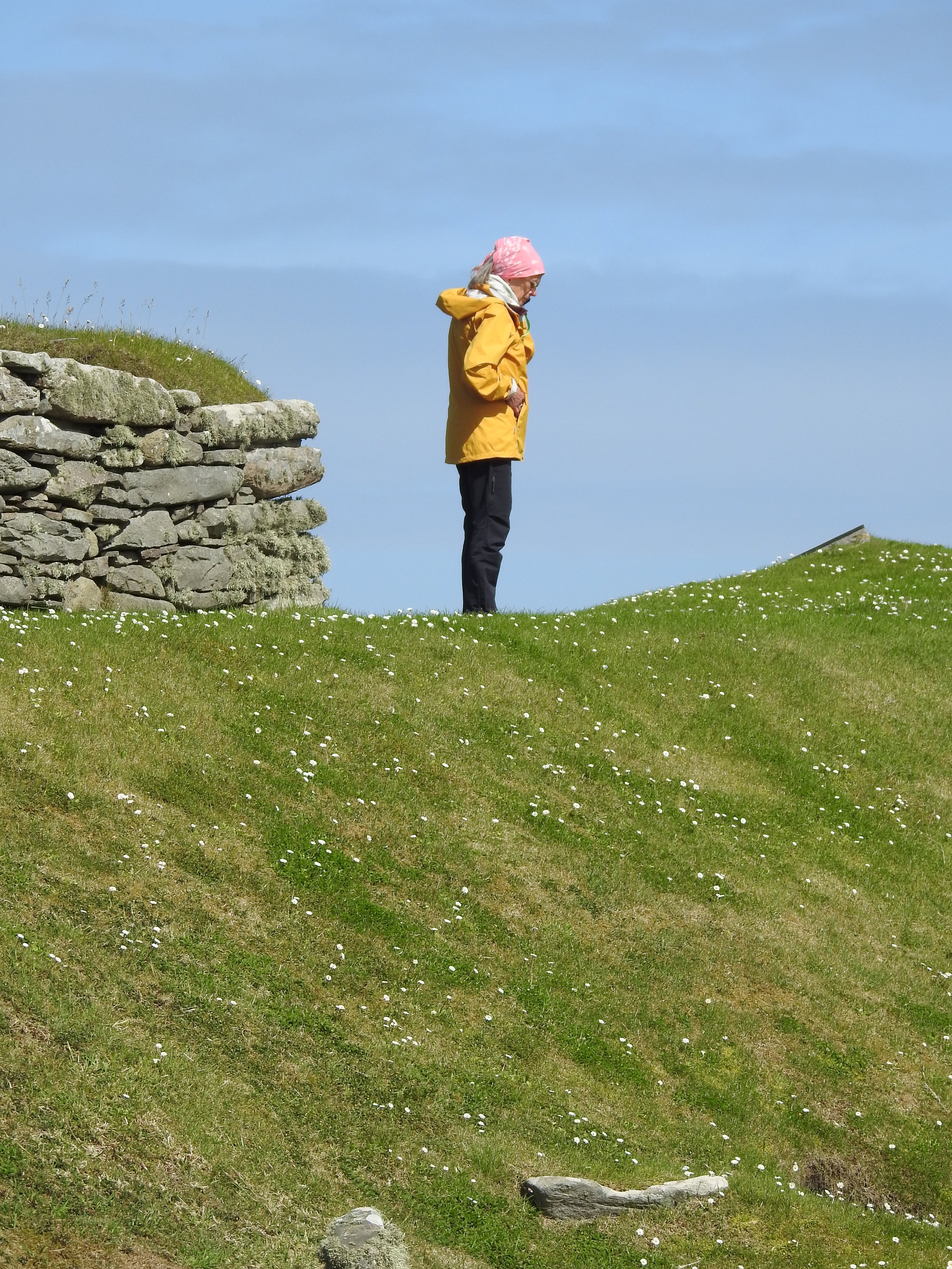
Time is also measured in Shetland, as it is in other places, in the museums that preserve the artifacts and stories of the past. The Tangwick Haa Museum, a small affair, tells the stories of the former owners of the Haa or grand house (before it was a museum) and the citizens of Tangwick. They led hard lives eking out a subsistence from farming and fishing, and for women knitting, always knitting. One photo showed two women in long skirts, burdens on their backs, standing in the road, chatting and knitting. The crude, handmade utensils of the farming class contrast to the “wealth” of the Haa owners who enjoyed luxuries like ceramics and dinnerware, things they would have gotten through international trade. Part of the challenge in visiting a place like Shetland is interpreting place names and words like “haa” and “broch” and “voe,” which are in “Shetland” a mix of English, Scottish and Norse.
For the summer solstice, we went to the Broch of Mousa, crossing over at 10 pm in the misty light of the northern summer to see the storm plovers. To me it was all eerie and dizzying—the fog and mist at sunset turning to fog and mist in the dark.
The towering stone broch built over 2000 years ago is now home to returning storm plovers that fly and soar and swoop around the tower, wings beating at infinitesimal speeds. The sounds of the scores of birds nesting in the double-walled structure made a whirring sound that edged on comforting white noise and the squeech of small birds, accompanied by my ringing tinnitius in my ears, the noise added to my feeling of unbalance.
The Mousa guide took us over in an open-air boat, about 65 sitting bunched together, life jackets fastened, and then walked us to the broch, stopping at times to tell us about Mousa. He was heavy set with spare lips that hardly moved as he stopped to tell us about the broch, the island’s history—how the wife of a 17th-centry laird had been taken there because she drank too much but then made her own business in running liquor (is this another story about dealing with a strong-willed woman?)--and about the birds and how their migrations have been studied, how they return to this broch year after year. At times he was funny, but he was usually hard to hear.
6/23—Today we did Ronas Hill, the highest summit in Shetland at 450 meters. It was rainy, drizzly when we started out (I am finally learning about layers, rain gear, and where to stash things in my backpack). On Ronas there are no paths, no sheep trails to follow. Doug pulled out his topographical map and a compass and asked if anyone could read them in case something happened to him. Of course, Wally stepped up. The terrain was boggy, soggy in places, rocky and graveled in others, tiny Arctic Alpine plants, lichen, fungi, Alpine azalea, tenaciously enchanting our way through the litter of rocks, a tiny golden frog hiding in a bog. As we ascend, strips that indicate movements over time of the rocks downward, as if some giant farmer had dug terraces to grow ethereal crops. We followed Doug over several hills on the way to the summit; with each hill we saw another ahead of us until we finally reached the top, above the fog/mist/clouds, where we could see the land, islands, lakes, around about—glorious views of the oceans and outlying islands.
At the very top of the hill, we ate lunch at the ruins of some cairns that may have been burial sites; one has a metal plate, a trig point, to indicate the four directions for surveying and mapping. One imagines a crew of hardy Iron Age men or Norsemen carrying the body of man (woman?) important enough to warrant such a trek to a final resting place.
Back in the van, headed back to Busta House, we saw a grand rainbow arching across the sky, the violet strand visible and spreading good cheer and good luck. Shetland fiddle music playing on the radio, the sounds of Tom Anderson and Aly Bain.
Our group of explorers is starting to mesh and to get to know each other over dinner and breakfast conversations. We are an eclectic group with lots of interests, and yet we all have stories about playing Scrabble. It is interesting how a game like that crosses over generations and nationalities. I remember that my grandmother was a cutthroat Scrabble player. I am really enjoying the conversation and the ways our different perspectives and experiences bear on discussions about language, history, archeology, geology. Riana and Fran are fluent in English and Afrikaans; Therese is a retired medical professional and avid traveler from Tasmania; Helene taught French but is also fluent in German, English, and Italian; Doug, a naturalist, is studying Gaelic. What a pleasure after not having such conversation in I don’t know how long to discuss whether we call the vessel that transported us from Aberdeen a ferry or a boat. We settled, jokingly, on ferry boat.
6/24—After having stared down at bird colonies and nestings from the edges of cliffs, we now were to look up at them from the perspective of the sea, from the Noss Boat that took us from Lerwick, around Bressay Island and to the Isle of Noss. Phil Harris, the boat and bird captain, is clearly fond and knowledgeable about the birds, funny as anthropomorphizes the birds. From his boat we saw the birds of Noss, spectacular bird colonies lined up on shelves on the cliff sides, some in rows, some grouped together, sitting on nests, groups of “teenagers” hanging out on larger shelves and rock tops, a couple beaking and pecking each other, others diving and swooping, bobbing in the sea as they carry bits of nest building materials in their beaks.
The show really began when Phil shot fish into the sea and the pretty gannets came shrieking and diving, like Olympic divers, into the sea to get the fish and pop out, a fish dangling from their beaks before they swallow it whole in one gulp. When another blast of fish is shot in, the birds shriek to each other “fish,” “fish,” circle the air, and then dive for the fish. The water is clear enough that you can see their white bodies underwater.
Afterwards, a quick walk to the van, saw the Lerwick Police Station and star for “Jimmy Perez” of Shetland fame (I read two of Ann Cleeves Shetland novels during our trip). Then a lovely dinner at Fjara’s, the portobello mushroom risotto with “salad”—snap peas, peas, crisp carrot shavings. The best risotto I’ve ever had and one of the gustatory highlights of the trip. Accompanied, of course, by a glass of wine. When given the choice of a small, medium, or large glass of wine, I always chose “large.”
6/25—Tired today, some car napping. To get to Hermaness National Natural Reserve, we had to take two ferries, first to Yell, which was delayed an hour because the other ferry had broken down. And then to Unst, the northernmost inhabited island in the UK. After a morning of transport and ferrying, we stopped for tea and Tunnuck’s Tea Cakes (marshmallow/chocolate mounds like little puffed Moon Pies) at the Final Checkout Store and Café before hiking the Hermaness. Stopping for tea had become part of our routine, a great way to refresh the soul and body before continuing the adventure.
At Hermaness we followed the first and only board walk of our hikes, walking over meadows and bogs to the cliffs to see gannet villages and puffins (Therese got some great pictures). A spectacular view of the sea, the cliffs and gannets flying, swooping just beyond the edge, level with us as we ate our lunches. Luckily, we had internet service on that remote island so that I could do a little business on my phone as we waited for the ardent bird watchers to return to the parking lot.
On the way back to the ferry, we stopped at replicas of a Norse longhouse and Viking boat. One marvels at the feats and daring of early explorers and settlers, going over the North Sea in an open boat without even the crude enclosed areas of the ships that carried Columbus across the Atlantic and the Pilgrims to New England. During our week in Shetland, I have learned some about Norse/Pict/Scot/ Shetland history, something I had never thought about but which is very much alive here—in place names, stone ruins, and the hardiness and seeming loneliness of today’s inhabitants who make a living in a challenging land- and seascape.
At The Final Checkout Store and Café, one little store with items for a variety of purposes; the few choices inhabitants on the island of Yell Island have must be ferried over. The little towns of Shetland remind me of the sad pueblitos of South Texas—where things go unrepaired, where “make-do” seems to count, where stuff in the yards speak of levels of dishevelment, junkiness, old buildings jerry-rigged to modernize or reuse them in reconfigurations. Like the “frig libraries” that show up on roadsides in remote locations, an innovative DIY way of promoting community through shared readings. Much seems behind the times, isolated from the “world,” but it is the world to the folks who live there, to families who have been Shetlanders for generations, through ages of time even.
Fran and I remarked on the isolation of some of the homes, the little towns, the 900 people on the northern island of Yell; we would not like to live here because of the isolation, the lack of amenities we are used to, and the loneliness and perhaps over-reliance on a few people to make up your world. We agreed that a month away from it all might be refreshing, but not a lifetime. The little towns are such a contrast to the crowded Alpharetta/Atlanta (and Pretoria?) scene, where there is always a crowd, people gathered in public spaces, yet which constitutes a different kind of loneliness.
On our last day, we drove to Scalloway, a coastal town with cute houses and a storied castle. We stared at Scalloway Castle from behind the rock fence, the top being held together by scaffolding. It was built in 1599 and was the home of Patrick Steward, Earl of Orkney and Shetland. His is a story of early oligarchy and monarchy where the very rich live extravagant lives and care none for the rest of the people. Scalloway’s scallywag met his end under the blade of an early guillotine in 1615. Will today’s scallywags get their just desserts??
After a cup of tea, we went to Scalloway Museum and learned about the “Shetland Bus”—where Shetland fishermen and men of the sea aided Norwegian refugees when the Nazis took over Norway, running supplies, bringing over refugees, operating secret missions during the war. They exemplify humanity and courage, for many of these men lost their lives and faced dangers at sea and from the Nazis, a contrast to the selfishness of Patrick Stewart.
Back in Lerwick, we poked around in shops looking for some souvenirs and wandered through the Lerwick Museum and Archives. The Museum does a thorough job of exploring the geological, cultural, historical past of Shetland. Lots of artifacts, too much to take in on one day. Stopped to take a picture of the fictional Jimmy Perez’s house that sits in the waters of Lerwick.
After our last lunch together, potato and leek soup and crisps, we headed to the ferry for the return trip to Aberdeen. Leaving Lerwick on the ferry, sitting at a window watching it/us go by, an absolutely brilliant sky and sea, the green hills, gray slag lining the edge between land and sea; hills and mounds, clouds—puffy, whispy, horizontal—I felt sadness at leaving, but ready to go home.
We had a wonderful if strenuous trip, physically challenging, but I learned about a place and history that had not been on my radar screen, and I met and got to know our fellow travelers from different places in the world.
Back in Aberdeen—after a nap at the hotel, we went to the Gordon Highlanders Museum at the home of artist Sir George Reid. It traces the history of the regiment and the various wars it played a part in through displays of weapons, uniforms, silver service and goblets. A lovely garden with memorials to various regiment members. A guided tour of a re-imagined WWI trench, like the one Grandad Taylor may have been in when he was a teenaged soldier. The hardships these men endured in spaces that became a kind of home, where death could come whizzing in at any moment.
Our flights for Saturday were cancelled, but Wally got us seats on the same flights for Monday. Luckily, we had a motel room where we could wait comfortably. We took advantage of one extra day to walk around Foot Dee (Fittee), a complex of small granite homes made for sailors in 1909, cute little homes decorated with plants, clever signs, ornaments. Then a walk along the beach—other folks out walking, sunbathing on the beach. Food trucks lined up on the street. Walked to Molly’s in the Aberdeen Douglas Hotel for lunch, salmon crostini for me.
Then finally home. This was one of those once-in-a-lifetime trips, at least for us. The vistas and stories of Shetland will remain ever in our memories and conversation like the small stones, shells, bird feathers I collected on our wanderings, artifacts of Shetland that now sit with my books. As we continue to read Ann Cleeves’s novels of crime and intrigue in Shetland, we can recognize places, historical events, and have a better “feel” for the location of the novels than we did before. The real and the fictional mingle together in my imagination and memory.